Friday, May 22, 2015

Thursday, May 21, 2015
Noah '40' Shebib: Recording Drake's 'Headlines'
Inside Track | Secrets Of The Mix Engineers
People + Opinion : Artists / Engineers / Producers / Programmers
Drake's atmospheric, brooding sound has revitalised hip-hop, selling millions in the process. The man behind that sound is Noah '40' Shebib.
Paul Tingen

Noah '40' Shebib.Noah '40' Shebib.Photo: Ruben Rivera
Canadians are prone to giving their own, unique slant to North American culture, and rapper Drake is a case in point, having scored major commercial success with a message, delivery and sound all his own. The 25-year-old sings and raps about self-doubt, melancholy, angst and the trappings of life, over sparse, ambient, slow-jam-like tracks dominated by brooding synths, minimalist piano or guitar parts, stripped-down, often muffled drums, and cinematic atmospheric treatments.
In fact, Drake's backing tracks have such a strong identity that the man responsible is becoming known in his own right. His name is Noah '40' Shebib, and on the phone from his native Toronto, he recalls how Drake and he were sweating profusely when they self-released their first collaboration, the mixtape So Far Gone, in February 2009 (it had a big-label release in a slightly altered form as an EP in September of that year). "I started out as Drake's engineer, and I wasn't there to produce or give creative input,” explains 40. "I was there to track and mix. But when he was working on So Far Gone, I saw how frustrated he became looking for music. He had worked with producers from everywhere in the world, and there was nothing that they came up with that he was happy with. At that point, it became clear to me what he was looking for and I simply started to produce it. We didn't set out with a deliberate ambition to completely break the rules and have singing and rapping and motion and melody. Instead it was more a matter of Drake asking for the drums to be taken out of a track, or for me to 'lo-fi' an entire song, and me initially saying, 'You can't take the drums out, the record won't move,' or 'You can't take all the top end out' — and then me realising that I could, and that it would give a unique perspective on his message.
"In an R&B song there are four sentences per verse, but in a rap song there are four sentences per bar. There are so many more words that I experimented with how to frame them, and that developed into something new. Instead of simply going for the 'bang pow wow' factor, we explored all kinds of things in the arrangements and in the music, and were in a situation where it was fun to be breaking rules and crossing boundaries. We were making music in a very different way. This turned out to work in our favour. When we first put out So Far Gone, we were really scared, but the reactions were so good that we decided to embrace doing things differently. It gave us the courage to continue. We'll still put out records that are obviously commercial and foolproof in hitting the charts. But then a song like 'Marvin's Room' has so much bottom end, you'll be hard-pressed to find a sound system that's not going to be destroyed by it. It was a matter of us wanting to have fun and make a record that would make a whole club shake. I wanted something that would be very dark and quiet and muddy and with the vocals cutting through like a razor. It was done at a studio in LA that had previously belonged to Marvin Gaye, and I made the beat one day, we turned it into a song the next, I mixed it the third day, and 48 hours later we released it on a blog on the Internet, and then the record went global and sold 500,000 copies! And we never even meant for it to be an official single!”
'Marvin's Room' was released on October's Very Own, a blog site created by Drake, 40 and Oliver El-Khatib, on June 9, 2011. It was meant to be a 'teaser' for the rapper's second full album, Take Care, which was released in November and sold 631,000 copies in the first week after its release, reached number one in the US and number five in the UK, and has by now sold 1.5 million copies worldwide. The official lead single from the album and the main subject of this article, 'Headlines', was released in July 31, also on October's Very Own, and sold in similar quantities to 'Marvin's Room'.
Complete Control

Drake studies the console at Metalworks Studios, where 'Headlines' was mixed.Drake studies the console at Metalworks Studios, where 'Headlines' was mixed.
While the majority of the tracks on Take Care were created by Drake and 40, the rapper's albums also feature other big-name producers like Boi-1da, T-Minus, Just Blaze, Swizz Beatz, Needlz, Kanye West and Timbaland. 40 is adamant that these were chosen by him and Drake, without record-company involvement, "Of course. We haven't spoken to an A&R man, ever. No questions, nothing. The record company just said, 'This is great, make it happen.' It's a mind-blowing situation, really, for us to step in and be in full control, and be able to put our own material out on the Internet the day after recording and mixing it.”
The duo write and record almost all their own material at 40's home studio. "It's located across the street from my home in Toronto. It's literally simply an apartment in which I put up some dampening against the walls to try to get the reverb times down. It's very much a makeshift home studio. I have a main control room and a booth and a small room at the back. When you walk in, there's a huge producer's desk and console, which is the Control 24. But I don't really use it; I'm happy with just a keyboard and a mouse. The control room has a pair of Genelec nearfields and a woofer, and a pair of Sota 750 reference monitors. Sota is a legendary Canadian company that makes big reference monitors, amongst other things. I also have Bryston and Crown amps. There's a Pro Tools HD rig and all my other toys and keyboards, like a [Hammond] B3 and a Wurlitzer and my Studiologic Numa 88-key MIDI controller, which is my pride and joy. The acoustics aren't great, so I'm not going to mix in that room, but we can go in there when we want and get serious work done and it definitely cuts our cost compared to going into a real studio.
"I use both Mac and PC, and there's a very important reason for this. I am a laptop guy, because I always want to have the ability to tweak my mixes when I leave a studio, wherever I am, just with my laptop and a set of headphones. So when I'm using outboard gear, I'll always print these tracks back into my Pro Tools Sessions, retaining both wet and dry versions of each track, giving me the flexibility to choose. My PC laptop is a year and a half old, and it has a 3.3GHz, 12-core, i7 processor. It's a full-size chip, not a mobile chip, so I guess my machine is not really a laptop but more a notebook. I also need to place it on a table, as it's a bit chunky. It has 12GB of RAM, three solid-state hard drives, DVI/HDMI and so on. It's custom-made by a gentleman called Les Bateman, nicknamed Bates. He had a company called Music XPC, which was for a long time the only PC manufacturer certified for use with Pro Tools. When I bought this computer from him it cost me $6500, but you have to remember that it's still far superior to any $4000 Mac you can buy today, despite it being one and a half years old.
"I still use Mac because there are some inconsistencies between the two formats in the programming and software and sometimes updates are available on Mac but not yet for the PC and Windows. I want to be able to use anything at any given moment, so I'm constantly running two systems. My PC has an RME Babyface audio interface attached to it, while my Mac has the Apogee Duet 2 audio interface. I tend to mix at Metalworks, and when I walk in there I can simply pop the Digilink cables out of their computer, put them into my Magma chassis, which has two HDX cards and one UAD Quad, run that into my computer, plug in the screens and cables and keyboard and mouse from the studio SSL, and I'm patched into the SSL and their full-blown HD rigs.”
Sources Of Inspiration
 A quick look at the credits for Take Care reveals that Drake and 40 are eager samplers. Of the 20 tracks recorded for the most recent album, half are built around samples, taken from the likes of SWV, Gil Scott-Heron, Don McLean, Juvenile, DJ Screw and others — though neither 'Marvin's Room' and 'Headlines' contain any samples. 40 explains, "When growing up in the world of hip-hop, you look at samples as a tool and an instrument. Samples give an aesthetic to a record that is difficult to achieve without one, whether you are featuring the sample prominently or have it running in the background. So for me they are a tool and I reach for them for fun. Why not? I love SWV, so when I sampled their song 'Anything' for 'Shot For Me', it is because it reminds me of a memorable good time that I miss. It's a nostalgic moment. But I don't need to use samples. I wrote 'Marvin's Room' by myself with Drake — I also gave a couple of points to Chilli Gonzales, who played piano at the end, and Adrian Ecclestone, who is our guitar player.Drake's guitarist Adrian Eccleston features on Take Care.Drake's guitarist Adrian Eccleston features on Take Care.
"In hip-hop, you must write your own raps. If someone else were to write them for you, you'd have no credibility whatsoever, and you'd be out of the window immediately. But when it comes to the music, there's not really the same pride in writing it yourself. People don't care who wrote it, or where it comes from or what the sample is, they just want the hottest beat. They just want that and then put it out in their own song. Having said that, Drake and I do take pride in writing songs together, just the two of us. We'll start in an old-school way, with me on the piano or at my Wurlitzer, finding a chord progression, and he'll start singing some melodies. I'll record the keys, usually with a [Neumann] U87, and his scratch vocals. I'll use either a Sony C800G on him or, if he's in the control room, a [Shure] SM57. The mics go through a Neve 1073 or 1081, and I'll have an [Teletronix] LA2A on his voice, not hitting that too hard. These sketches will sometimes make it to the record. I'll sometimes sample them. If you listen to the song 'Hate Sleeping Alone' [from the iTunes version of Take Care], you'll hear all sorts of bits of background vocals in the background, which sing the same melodies, but without words. It's the scratch melody of Drake singing before he had written the words.
"We work slightly differently for each song, but one thing that I always do is drag and drop Drake's vocals. I arm one track in Pro Tools to record him, and I then drag the clip down to an empty track. I never switch tracks while recording. When he says he wants to sing or rap or do an overdub, I just hit Record. I always have an open mic in the studio. Another advantage of using drag and drop is that Drake does not want to hear the playback in the headphones before I punch him in. Normally, when you do a punch-in, you'll hear the track, then you hear yourself when you punch in, and then it goes back to the track. Drake doesn't like that, he wants to hear himself live at all times, just with a bit of reverb or delay for the feel, but for the most part pretty dry.”
Another common way of writing songs in hip-hop and R&B is to use a track written by another producer as a starting point, and in the case of 'Headlines', the starting point came from fellow Toronto producer Boi-1da who, with some help from one A. Palman, provided the basic string staccatos and synth arpeggios that resulted in a slightly more full-on and energetic arrangement than is usual for Drake. 40 elaborates: "Boi-1da sent us the beat as a stereo MP3, and Drake loved it, so I popped it into Pro Tools and Drake started going to town over it. He probably spent a couple of nights writing. I added quite a lot of stuff to it, like lead lines and extra basses and pads, some 808 rides, that sort of drive the record. All these additional tracks are marked '40' in the session.
'Headlines'

Noah '40' Shebib: Recording Drake's 'Headlines'
Written by Drake Graham, Matthew Samuels (Boi-1da), Noah '40' Shebib, A Palman. Produced by Boi-1da with additional production by 40.
 "At some point while Drake was writing to the stereo MP3, I was calling Boi-1da, begging and demanding all the exported separate files of his session. I then swapped those for the MP3 tracks, so by the time Drake had finished writing, he was working against the separated files, which I used to arrange the record. Some of Boi-1da original parts were removed or muted. I really buried my hands in the arrangement. I recall that we took all the drums out at that point, but then decided this didn't work, so we put the kicks back in. The arrangement got changed and edited and I added my parts, thickening the bass and adding pads and the melody synths. I looked at the Boi-1da track from a mix perspective and added things that I couldn't achieve just by mixing. We also called in Divine Brown to add some vocals, because there's some male-female call-and-response in the song, so she could give the female perspective and add thickness to the chorus. This happened over three or four days of Drake and I working alone at my studio.
The full Pro Tools session for 'Headlines'.The full Pro Tools session for 'Headlines'."I am adding plug-ins and mixing and tweaking the record as I go along, but at some point, once we know the record is real and we need to step it up a level, I take sessions to Metalworks Studios for the final mix. Boi-1da and T-Minus both use Fruity Loops to do their beats, and until recently it only spat out 16-bit files, so I almost always end up putting these through the 80-input SSL 4000 G+ at Metalworks Studio 2. I also stick them through some other analogue gear, like a Pultec, or Neve 1073s or LA2As. Metalworks have a bunch of great Pultecs, and I love hitting them! It's to give these files more feel and life, and I then track them back into Pro Tools at 24/44.1. You can upgrade a 16-bit file to 24 bits in the computer, but this doesn't add anything; plus in-the-box processing will give you bit loss and degradation, and by the time you spit it out, it won't be the same. From Drake's perspective, it's also nice to go to Metalworks, because they have a big room and we can get a crowd in there that he can entertain. They have a pair of Augspurgers and subs in one room that we can really crank up!
 SPL's Transient Designer plug-in was used to add 'point' to the kick drum.SPL's Transient Designer plug-in was used to add 'point' to the kick drum.40's processing chain for the sawtooth bass synth included Waves' Renaissance EQ and Bass, and Avid's Lo-Fi, a big favourite of his.40's processing chain for the sawtooth bass synth included Waves' Renaissance EQ and Bass, and Avid's Lo-Fi, a big favourite of his.Noah '40' Shebib: Recording Drake's 'Headlines'Noah '40' Shebib: Recording Drake's 'Headlines'Unusually, a single processing chain was used for the entire lead vocal on 'Headlines', including Waves' Q10, De-esser, Renaissance EQ and Vox, Bomb Factory's Pultec EQP-1A and Avid's Smack!Unusually, a single processing chain was used for the entire lead vocal on 'Headlines', including Waves' Q10, De-esser, Renaissance EQ and Vox, Bomb Factory's Pultec EQP-1A and Avid's Smack!Noah '40' Shebib: Recording Drake's 'Headlines'"After running the 16-bit stuff through the analogue domain, I remained in the box for this record. As I said before, our approach is always different, so in some cases I lay everything out over the SSL, in some cases I do everything in the box, and sometimes it's a combination of the two, like in this record. But a lot of my instruments are Pro Tools-based, so why would I want to leave the box? Everything is recorded at 24-bit, at extremely high quality, so apart from the issue with upgrading 16-bit files, it's rare that I think about running stuff through old gear and risk having crackles and other headache-inducing stuff. In general, I want it as clean as humanly possible. Mixing 'Headlines' happened very quickly. Most of the plug-ins on it were opened during arranging and tracking, and because of the vocal chains we use, Drake's vocals are in pretty good shape by the time the recordings are done. In general, the records are nearly finished. Drake suddenly said, 'Hey, let's put it out tonight,' and I replied, 'OK, give me a few hours!' So I took the session to Metalworks, where I put the Boi-1da stuff through the analogue gear, tweaked the rest in the box for three hours, and before I knew it, it was done.”
The Mix

The 'Headlines' session is meticulously organised, starting with a stereo track at the top containing Boi-1da's original backing, then 10 drum tracks from Boi-1da, four 40 drum tracks, four Boi-1da music tracks consisting of one low arpeggio and three string tracks, six 40 synth tracks, a drum master track, 12 Drake vocal tracks and one Divine Brown vocal track, a Drake vocal master track and the same for Divine Brown, four aux tracks, a general vocal master track and a general music master track, and the final stereo master. In total, there are only 37 audio tracks, and relatively few plug-ins, particularly on Boi-1da's drum tracks because, remarks 40, "I had passed his stuff through the SSL already and had done most of the processing I wanted during that process.” The eagle-eyed will spot the '-1380' markings in the comments box. Says 40, "I was working in full HD with TDM and then took it home to work on Pro Tools LE, and the first thing I always do is to check for latency, and I noticed that Auto-Tune was giving me 1380 samples of latency on every track it was on, so I compensated for that by hitting my great friend Alt-H, one of my favourite shortcuts in Pro Tools, and moving all the vocals 1380 samples earlier.”

Drums and bass: SSL desk EQ, SPL Transient Designer, Waves Renaissance Axe and Renaissance Bass, Avid Lo-Fi and Xpand!

 "I had the SPL Transient Designer on Boi-1da's kick,Noah '40' Shebib: Recording Drake's 'Headlines' to get it a little bit more snappy and pointy. There also are very few plug-ins on the drum tracks I added, including some 808 tracks, one of them being a hi-hat ride ['40808']. On the drum master track, I had a Renaissance Axe compressor, working minimally, with just a -1 setting on the threshold. Boi-1da had a 'Sawbass' track, which I hit with a bunch of stuff.Noah '40' Shebib: Recording Drake's 'Headlines'Noah '40' Shebib: Recording Drake's 'Headlines'Noah '40' Shebib: Recording Drake's 'Headlines' Coming off the SSL I had probably given it a little bit too much bottom, so when I was mixing I wanted to push its top end a bit, and instead of having a huge, rumbling, low bass, give it a little bit more pop and harshness. I wanted to shape it a bit differently. I pulled back on some bottom end with the first EQ, while also adding some air to brighten it up. That gave me a better balance to work with, and at that point I hit it with some Renaissance Bass, to give it something under 100Hz, and I added a bit of distortion with the Lo-Fi to give it some anger. I also added a bass track, using Xpand!, which is a stock plug-in in Pro Tools, and again adding the Lo-Fi, in which I pulled the sample rate down to 4400Hz, so it's degraded a lot. I also applied EQ, ducking at 95Hz, and then a little compression to level it out. I depend on the Pro Tools Lo-Fi a lot. I can't use the Waves or Air Lo-Fi, it has to be the stock Digi one.”
 Strings and keyboards: Pultec and SSL desk EQ, Avid Lo-Fi, Sansamp PSA1 and Xpand!, Waves GTR Solo.One of the main keyboard parts in the song was added by 40 using the basic Xpand! instrument in Pro Tools, routed through a Waves guitar amp simulator and the inevitable Lo-Fi plug-in.One of the main keyboard parts in the song was added by 40 using the basic Xpand! instrument in Pro Tools, routed through a Waves guitar amp simulator and the inevitable Lo-Fi plug-in.Noah '40' Shebib: Recording Drake's 'Headlines'Noah '40' Shebib: Recording Drake's 'Headlines'
 "I had the Pultec and some drastic outboard EQ on the first marcato string part, and a mid-range EQ and some drastic top-end EQ on the second string part, but left the third string part alone. If it ain't broke, don't fix it. Three of my five additional keyboard parts have the Lo-Fi, with, again, Sample Rate and Distortion being the buttons that I reach for. Those keyboards also have the Sansamp on them. 'Outro40lead' is my keyboard part, which is a synth lead. I used an instrument in Xpand! 2 and then the GTR Solo plug-in preset and, again, some Lo-Fi.”

Vocals: Antares Auto-Tune, Waves Q8, De-esser, Renaissance EQ, Vox Compressor and SSL EQ, Bomb Factory Pultec EQP-1A, Avid Smack!

 "Nine of Drake's 12 vocal tracks, as well as Divine Brown's vocal track, had Auto-Tune on them. On this record I actually tuned the raps! Drake raps in a very melodic way, which is a conscious decision on his part. I therefore hit it with some Auto-Tune to centre the pitch a little bit. If I left it off, I'd be surprised if many people would notice. It's just a bit of pitch-correction. But you can hear that it's perfect, which is abnormal, of course. In addition to Auto-Tune I also had the Waves Q8 EQ on 'Drake 1', and the Waves De-esser, the RE6, the RVox, a Pultec plug-in and the Smack! on the Drake master vocal track. I like the sound of the Smack! compressor, it adds some more energy and anticipation. The 'Reverb', 'Delay', 'Exciter' and 'Delay2' tracks are all aux tracks associated with the vocals on this record. I treated all the vocals on this song as one, which is a little abnormal: I normally have chorus processing and verse processing and rap processing, and so on. But for me, the feel of this record was of a guy on stage singing the song, so it had to be coherent from the beginning to the end of the song. I sent all my vocals to one bus, and the drums and music to another bus, so I could balance them against each other just before I hit the stereo bus. There are three more plug-ins on that final vocal bus: the RCompressor, SSL EQ and Q8.”
The Way Out

As well as working with Drake, 40 has also contributed to the success of Abel 'The Weeknd' Tesfaye (left), who guests on and co-wrote several songs on Take Care.As well as working with Drake, 40 has also contributed to the success of Abel 'The Weeknd' Tesfaye (left), who guests on and co-wrote several songs on Take Care.

 "There's a [Waves] Linear Phase EQ and an L2 limiter on the master bus, which I use when printing reference mixes. I take the L2 off when I send the track to mastering, though I'll leave the EQ in sometimes. This song ended up being, for my doing, a little bit thin, other than some good bottom end in the chorus from the bass lines that I added. But I love the fact that the vocal is really loud and in your face. I hate the loudness wars and that artists and critics mistake loudness for quality, and I tried to stay away from it for most of Take Care. But because 'Headlines' was a roll-out single for the album, I wanted it to jump out when it came on the radio, and part of that was not having so much bottom end, which gave me the headroom to push it a bit further. Bass and kick take up so much headroom, but this song is more snare-driven. So I did my best to make the song super-loud and more impactful on the radio. Because a song like 'Marvin's Room' has a lot of bass, I had to do quite a bit of tweaking during mastering to make the whole album fit together. But it's part of the fun Drake and I have in fighting all the boundaries and limits, whether from a mix or a musical standpoint. We're just a couple of kids making records and it has worked out pretty good for us!”

It's an unassuming, and very Canadian, approach. .
The Top 40
Noah '40' Shebib was born in Toronto in 1983 to an Irish-Lebanese father, and was a bit of a child prodigy, acting in Canadian TV series like The Mighty Jungle, Goosebumps and Wind At My Back. This experience informed his later successes as an engineer and a producer.
"I left school at age 10 to be able to act full-time. I grew up in the entertainment industry, with my family being actors and so on. I knew from a very early age what being an entertainer or creative person involves having to work every day to make sure you have an income and a career. I also preferred to be behind the screen rather than the person on the screen. I don't like the limelight too much. For those reasons, I always leaned towards the technical side — it had substance, whether you liked it or not. When I was a kid, I used the money I made from acting to rent a four-track tape deck and digital samplers, and I also had Sound Recorder on Windows 3. I used anything I could lay my hands on, whether consumer-level or entry-level pro stuff. When I was 12 years old, I had a little setup in the basement, with a Tascam four-track tape deck and a Roland SP202 sampler, and was making music. I'd already been programming DOS code as a six-year old kid, so when computers kicked into gear it was second nature to me. I worked with a program called Sonic Foundry Acid 3.0, and by age 12 or 13 I was fluent in any computer platform. I also started DJ'ing when I was 13, something that pulled me into the world of hip-hop. And I'd been playing piano since I was four years old, and also had a love of physics and mathematics. All these things pointed me towards a career in recording studios.”
They also pointed towards great things to come, but even someone as precocious as the young Noah Shebib had to pay his dues. He recalls, "At 19, I went to the Trebas Institute in Toronto to study audio engineering, but left after five months, because I felt I wasn't learning anything. At best, I was being reassured of things I already knew. I left to do an internship with Noel 'Gadget' Campbell, a well-known mixer in Toronto, who became my mentor and whom I work with to this day. Even 10 years ago, there was not much of a studio industry left, so I was very lucky to get to work with him. I was also lucky because Gadget worked me really hard; he didn't let me sleep. In being put through the wringer by him I really earned my stripes, so when I later walked into studios in New York, LA or Miami, I could do everything that the engineers there could. One night at 3am, I'd already been working non-stop for two or three days, Gadget walked into the control room and said: 'Listen.' He had a CD changer with 300 of his favourite discs, and all kinds of music, and we'd listen to music and talk about it until 1pm the next day. He then looked at me and said: 'Your ears are tuned now.' I understood that you need reference points to be able to hear music properly, and when you go back to your own music, you can hear right away what's right and what's wrong.”
Campbell ran a label with Chris Smith, called Blacksmith, which was licensed to Universal, and for which 40 engineered albums by rapper Jelleestone and R&B singer Divine Brown in 2004. 40 also produced two of the songs on Brown's album, one of which, 'Old Skool Love', became a gold record in Canada. It was during the Jelleestone recordings that he earned his nickname. "I'd always be sitting at the console, so they called me 40/40, meaning 40 days and 40 nights, because I never slept. That evolved into just 40. The Brown and Jelleestone records were my first major-label projects, and the former put me on the map. But after that I decided to focus on just engineering and mixing, and that's what I was doing when I first met Drake. I'd grown tired of making music and didn't have any reason to make beats. In working with Drake, I found my reason, so I stepped back into producing. Drake had gone through a lot of trial and error to identify his sound, and I had clear-cut ideas. I knew what it needed to sound like. Is it a Toronto sound? Well, there are tons of producers here in Toronto that inspired me when I was a youth, like Gadget, Saukrates, Kardinal Offishall, Mr Attic, Mazzaman and Agile.”
Wednesday, May 20, 2015
Jan 'Stan' Kybert: Producing Paul Weller's Sonik Kicks
Inside Track | Secrets Of The Mix Engineers
Paul Weller's latest album was brimming over with musical creativity. The challenge for mixer Jan Kybert was to forge a coherent album from a mass of ideas.
Paul Tingen
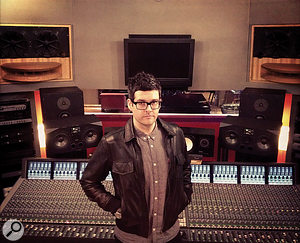
Jan Kybert at Dean Street Studios.Jan Kybert at Dean Street Studios.
Paul Weller is four years into a widely acknowledged creative roll, beginning with his 2008 album 22 Dreams and continuing with 2010's Wake Up The Nation. This year's UK number one album, Sonik Kicks, is his third successive creative peak, and makes extensive use of electronics, cut and paste, dub techniques, and Krautrock-style rhythms. This might sound like a strange departure for a man mostly known for British soul and guitar rock, but on Sonik Kicks the old and the new are seamlessly integrated.
The album was co-produced and in part co-written with Simon Dine, who performed the same roles on 22 Dreams and Wake Up The Nation, and features several other long-standing cohorts, such as guitarist Steve Cradock and Britrock luminaries Noel Gallagher and Graham Coxon. Sonik Kicks was mixed by Jan 'Stan' Kybert, who previously engineered and mixed Weller's 2002 album Illumination, and co-produced 2004's Studio 150 and the following year's As Is Now. Sonik Kicks was recorded at Weller's own Black Barn studios, and Kybert's work in completing the project earned him an 'additional production' credit.
Too Much Going On
"When Paul is making music, I often go to his studio to listen to it,” says Kybert. "I did this in March 2011 and he played me about 15 tracks. I remember thinking that there was a great album in there, but that there was too much going on. It was very layered and lacking in definition and dynamics. Six weeks later, Paul called me and asked me to have a go at mixing three tracks for the album, and if he liked what I did, I could do the whole album. So I booked four days at Dean Street Studios and mixed these three songs. Paul liked what I had done, and asked me to book another two weeks. This was during May, and we mixed half the album, took a couple of weeks off, then did another three weeks of work at Dean Street, took a month off, and did another week of recalls and adjustments and piecing the entire album together.

Sonik Kicks was mixed on the SSL Duality at Dean Street Studio 1.Sonik Kicks was mixed on the SSL Duality at Dean Street Studio 1."A lot of the album came into being through a free-form writing process. Simon [Dine] would create backing tracks and loops with beats and samples and synth sounds, and then Paul would try vocal melodies and guitar parts on top. A lot of the stuff that you think is synths is in fact Paul going through several guitar pedals, often using his Danelectro guitar. They didn't use plug-ins to create synth sounds. It was all very organic, even though it wasn't a traditional approach to songwriting. Paul did write a few songs in a more traditional way, like the acoustic guitar ballad 'By The Waters', but tracks like 'Green' and 'That Dangerous Age' are very free-form.
"One reason why there was so much going on was that almost all parts started at the top and continued to the end. When they wanted to hear something, rather than take something out, they'd add something new, so there were many, many layers of material and my job became to sift through everything and arrange what was left.
"The joy for me was that they were all killer parts, by Paul, Noel Gallagher, Graham Coxon and others. I had one of the best times of my career last summer, because it was great to sift through all these fantastic parts. For me, it was dream stuff. But there would be three bass guitars on some tracks, with stereo room on the bass, for example! So everything needed to be much more defined. Paul is very encouraging and he pushed me to be bold. When I began mixing, I said to Paul that I preferred being alone while doing this, and that I'd call him when I was ready for him to come down. He was happy with that. I spent 90 percent of the time on my own, and then Paul would come in and add ideas to pretty much every mix. I never put a mix down without him hearing it first. In some cases, we mixed a track more than once, like I mixed 'Around The Lake' three times. When you are sifting through so much stuff, the way you are mixing is evolving, and it went from being this weird track that we didn't know where to fit in to a pivotal track for the album. So much so that Paul released it as the first song off the album, as a free download.”
Stan The Man

Jan 'Stan' Kybert: Producing Paul Weller's Sonik Kicks
Jan Kybert is, by his own account, "known for making music that features two guitars, bass and drums.” He began his studio career in 1993 as a runner in a tape store at the Townhouse in London, and after six months was sent to work at Olympic, where he quickly moved through the ranks. He met mix legend Mark 'Spike' Stent here, who became a friend and nicknamed him 'Stan'. Kybert became Stent's Pro Tools operator, working on classic records by Massive Attack, Björk and Oasis, and was one of the first people — if not the first person — to receive a credit as 'Pro Tools operator', on Oasis' Standing On The Shoulder Of Giants (2000). Although Kybert went freelance in 1999, he spent most of the next eight years as in-house engineer at Oasis's Wheeler End studio, where Noel Gallagher introduced him to Paul Weller. He has also worked with New Order, the Prodigy, UNKLE, the Draytones and recently Noel Gallagher's High Flying Birds.
Since Wheeler End closed in 2008, Kybert has spent a lot of his time working at Dean Street Studios in central London, where he mixed Sonik Kicks on the 48-channel SSL Duality desk in Studio 1. "That board was essential. It's a great compromise between the G-series and working inside of Pro Tools. For me, it's the perfect combination, the perfect interface between old school and new school. I love it. Paul and Simon had already gone to town with lots of effects during the recordings, so I didn't need to add more weirdness or excitement. I needed to bring structure to the excitement. This meant that I didn't have to use a lot of effects, whether outboard or plug-ins. Instead, the compression and the EQ on the Duality, as well as muting, balancing and panning, were my main tools.
"During mixing, my outboard consisted only of an Alan Smart SSL Quad compressor on buses 1 and 2, for the kick drum and snare, and a Bricasti M7 reverb. The stereo mix went through another SSL Quad and the Prism MEA2 stereo EQ. Spreading things out over the board helped me to know what was going on and organise my material. I did it in a very traditional way, with the bass drum on channel 1, the snare on channel 2, hi-hat on channel 3, and so on. I always had the lead vocal coming up on channel 25 on the desk. The lead vocal is the most important element of the song, of course, so I'm always referencing it and working on that in the sound field in the middle of the speakers. I ran the vocals through a [Universal Audio] LA2A, compressing it on the insert with that and with the compression on the board. I rode the vocal quite a lot, pretty much on every word.”
Despite being in the vanguard of the Pro Tools generation, Kybert is not keen on working purely 'in the box'. He explains: "I needed to able to balance things quickly, to hear things at different levels, and what the track did and didn't need, and for that, faders are very practical. To be able to sift through things quickly, you have to have it on channels on a desk. Some sessions had more than 100 tracks, and so it was important to organise things well, also with regard to submixing in Pro Tools.
"For this reason, colour-coding the Pro Tools Session was very important on this record. I've always mucked around with colour-coding, and at the beginning of every session, Austen Jux-Chandler, my assistant and Dean Street's in-house engineer, would group everything for me, with drums in blue, bass in yellow, purple for guitars, green for keyboards, red for vocals and so on. This gave me a good visual reference. When I was sitting at the board, I could have a quick look at the screen and immediately know what I was seeing, without having to go over to the screen and sift through things. It just makes your life easier. I grouped things in a similar way on the board, though I didn't colour-code the board.
"I was one of the first who was recording bands with a computer, but I still prefer listening to looking, and that was another reason why the Duality was so important. When you're creating music, you should not be looking at a screen. Screens in studios tend to be so big now that it is hard to get away from them. And they do influence your hearing. You're talking about creative people and they're looking at a screen full of colour, which is like a revolving piece of art, so it's going to be influential! Often, when I'm talking to an artist they are listening to me and at the same time trying to work out what they're seeing on the screen, so in effect they're only half there for the conversation, let alone the music. It's a distraction that subconsciously influences you. Even if it only takes 10 percent away from your listening, you should not be looking at it.
"On average, I took two days to mix each song. I didn't want to work on more than one song on each given day, because the mixes were too intense to be able to quickly go from one to the other. I needed to be very focused on what I was doing in each song, so I'd finish a mix before I moved on to the next one. Towards the end of the project, we did do some recalls to tweak some things: as the album came together, some of the things in the initial mixes needed readdressing. It was like a jigsaw. The Duality came in handy here, and the more I got into this record, the more I loved the desk.
"I started each mix session with listening to the bass drum, and then I'd listen to all the drums to see if anything needed replacing or adding to, and I'd then mix in the bass guitar and push the guitars up, and after that I did any programming the drums needed around that. Throughout, I'd throw in the vocal to make sure it was sitting well with those elements. This was the beginning stage. After this, I'd pull everything down again and start with EQ'ing the drums in detail, then the bass guitar against the bass drum, making sure you have lots of both but that they aren't clashing. The snare is sitting on top of that, and I could start adding the ambience on the kit and hats and whatever was around that, and I'd then gradually add in all the other elements.”
'Green'

This composite screenshot shows the entire Pro Tools Session for 'Green'. Note the extensive colour-coding and use of groups (as shown at left).This composite screenshot shows the entire Pro Tools Session for 'Green'. Note the extensive colour-coding and use of groups (as shown at left).
"'Green' was initially placed as the fourth track on the album, but the moment I heard it I thought that if it was mixed correctly, it would be a real sonic kick and should be the album's opener and a reference point for the entire album. Paul has always been good with titles, and the word 'sonic' was a real key for me while mixing. It was a source of inspiration. The Session probably had 100 tracks. I always was given a rough mix, which I would have running alongside the Session as a reference so I had an idea of the direction and the key elements in the song. In 'Green', these are the spiky guitars and the pulse-y synth. The first time I heard the track, the synth was loud and linear from the beginning, but in the final version it is constantly panning and moving around.
"There's quite a Neu! Krautrock reference in this track, and the bass, snare and the rest of the drums needed to be throbbing, so I programmed quite a few additional drum tracks. The tracks that are marked '808' were all added by me. 'Fil11' contains some live drum fills, and the four tracks underneath are live drums. Again, you can see that there are very few plug-ins on the Session. There are a few Digidesign EQs on the drums, and 'b' on the 'Fil11' is a Bomb Factory compressor, but that's all. The main treatments on the drums were done with the SSL Quad EQ on the snare and bass drum, and everything was compressed and EQ'ed on the Duality, which has a killer sound.
"On all the mixes for Sonik Kicks, I re-recorded the bass from the DI track because I wanted a different bass sound. The DI'ed sound in this session is track 'BA11', and I sent it through Dean Street's Ampeg B15 bass combo from 1970 and re-recorded that. The 'E' on the DI track is the Digidesign EQ and the 'm' plug-in is the Moogerfooger, to add some phasing and fizz to the bass. The Moogerfooger is a great plug-in. When I effect a bass track heavily, I tend to roll off the low end and just keep the top for drive and definition. You don't want to have distortion in the low end of bass because it's too undefined, even below 120Hz. So I'd got a really punchy Ampeg bass sound, and I then mixed in the EQ'ed and treated DI track with that.
"The 'BWP' tracks immediately underneath the two bass tracks are backwards piano, which are again treated with a Digidesign EQ. Underneath that is the pulse synth. It was made up of three different sounds. It had a long delay on them and I sent them to one fader, with which I manually panned the synth every bar and then copied and pasted that in the song. The mix panning is quite extreme, I was kind of thinking of the iPod generation: it's psychedelic on that! Underneath the synth are the guitars, with 'm101' being a Monotron track, which was Paul's guitar going through a Korg Monotron pedal, which was part of the experimentation that they did. There are quite a few guitar tracks, but I hardly did anything on them in terms of treatment, other than the Digidesign EQ on some of the guitar tracks, and then EQ and compression on the Duality. At the bottom of the session are the vocals, on which there were hardly any plug-ins — only compression and EQ on the desk, and maybe some Bricasti reverb.
"At the top of the Session, you can see two stereo mixdowns. Paul wanted to put all mixes to tape, so we did both digital and half-inch analogue tape passes. The digital mixes went via the Cranesong HEDD 192 A-D converter back into Pro Tools. We first A/B'ed the Cranesong with the Pro Tools converters and the Cranesong was the clear winner. We then A/B'ed the digital with the analogue mixes, and the digital versions won in all cases. It was punchier in the bass and clearer in the high end. For 'Green', I also did two alternate digital mixes without vocals, and edited sections of these mixes into the main digital mix. You can see the cuts in the screenshots. These were hard edits on the beat, which created real punchy snaps between sections.”
'That Dangerous Age'

In contrast to 'Green', 'That Dangerous Age' was a much simpler and smaller mix.In contrast to 'Green', 'That Dangerous Age' was a much simpler and smaller mix.
"This was one of the more straight-up mixes. I could hear what the track needed straight away. I envisioned it as having a kind of hip-hoppy beat with a really groovy bass, so I needed to get the drums and bass rocking, which took quite a bit of work. I added a couple of snare and bass drum samples and again re-recorded the bass, to get the bass line really defined. The 'L's are low-pass filters. Then I mixed in the guitars, which were really spiky. The beats and the spiky guitars create something very contemporary, very modern together. Paul says that the song doesn't have a chorus, just a verse and a bridge, but in my mind the verse is the chorus, because it is really hooky.
"Once I had the drums, bass and guitars in there, it was a matter of bringing out the best in the vocals. I put some reverb spins on the vocals that happen at the end of the second bridge using [Audio Ease's] Altiverb in AudioSuite [ie. offline]. The first time it sounds like a long reverb tailing off, the second time, at the drum drop, I played around manually with the pitch of the reverb. The way I did that was by duplicating a track without audio, so it has the same treatment as the original track. I then took the word that I wanted to process, 'far' and put a really long reverb on it. I could then look at the reverb audio in AudioSuite and manipulate it.
"When you use a regular plug-in, you have to play the track every time to hear the effect, and you can ride it, but you can't put a plug-in on that reverb. You'd have to set up another aux to another send. Instead, in AudioSuite I can automate and re-treat it with another plug-in. In this case the reverb became a melody part, making the listener hopefully a little confused about what they're listening to. I apply this effect often with Altiverb, and sometimes with [Sound Toys] Echo Boy, instead of just setting up an Echo Boy track and spinning it. It helps you to be creative with plug-ins, which I think is important. Otherwise you sound like everybody else.”
'Dragonfly'

Another composite screenshot, showing the smaller Session for 'Dragonfly'.Another composite screenshot, showing the smaller Session for 'Dragonfly'.
"This one of my favourite tracks on the record. Mixing this track was mostly doing a clear-out. I was getting rid of a lot of stuff. It had quite a complicated drum part full of edits and with lots of looping. The rough mix for this track was very guitar-heavy, and I sifted through the material and wasn't too keen on the direction, so I took the decision to make the song acoustic guitar-led. It felt more psychedelic with the acoustic guitar leading it. In the rough mix you would not have known that there was an acoustic guitar in the Session.
"I selected an acoustic guitar part and looped that throughout the track. I then got rid of the electric guitars in the first half of the song, and made up an outro that should be uncomfortably long and that has an electric guitar coming in. Again, mixing was a matter of being creative with the audio that was there, rather than effecting it.
"The 'E' on the drums is the Digidesign EQ and the 'T' is timing correction, which was already in the Session. If it sounded good, I left it alone. 'Mr04' or 'Marco' bass was a really cool effect, where they had put the bass guitar through a Binson reverb. They had been doing lots of stuff like that, also running vocals through Binsons and Echoplexes and so on. In this Session there's the 'BN02' track, which is the lead vocal track put through a Binson. I heavily automated the volume on that. When people record the effects back into Pro Tools it makes it easier to work with because you can ride these tracks without riding the effects on them. 'Bwa' is a backwards acoustic guitar with a Bomb Factory plug-in on it and 'c105' is the main, picked acoustic guitar part.”
Two Sides
Jan 'Stan' Kybert: Producing Paul Weller's Sonik KicksJan 'Stan' Kybert: Producing Paul Weller's Sonik KicksPaul Weller at the piano in his Black Barn Studios, where Sonik Kicks was recorded.Paul Weller at the piano in his Black Barn Studios, where Sonik Kicks was recorded.Photo: Lawrence Watson
"Paul and I both still think of an 'A' and a 'B' side when working on an album, so after everything was mixed, we created a track order with two sides, each being different parts of the ride, with continuity in them. In our minds the break between the two sides comes after 'Study In Blue', and 'Dragonfly' is the opener of side two.
"We finished the album in the first week of August, and it was mastered by Howie Weinberg in LA that same month. We didn't want the tracks to be mastered too loud; I had put a lot of effort into creating dynamic mixes and I did not want them squashed. Howie mastered three tracks twice, with one version less compressed than the other one, and we went for the latter one. That became the theme for him during mastering, and as a result he was working more with EQ than with compression. I consider these the best mixes that I have ever done, and he still managed to step them up by 20 percent! Paul didn't want an autumn release, so the album was released in March of this year.” .

Perfect 10s
Jan Kybert is one of many top engineers and mixers who continue to swear by the Yamaha NS10 monitor speaker (see /sos/sep08/articles/yamahans10.htm), 34 years after its introduction. "I love the NS10. For me, a Bryston amp and two NS10s are it. I'm a big believer in the idea that if you can get a mix rocking on the NS10, it will sound fine on anything else. If you have a good-sounding room, and you get it pumping on the NS10, it will pump on the big speakers. The 10s are relentless and unforgiving, and those are the two qualities that make me adore them. They don't change, they don't go out of fashion, and they sound like they always have done. I know them inside out, and when you're mixing it's great to have that familiarity with the sound.

"They don't have the best low-bass response, so to check general levels of bass, as well as vocal levels, I use my ghettoblaster, which has a sub in it and which is fantastic for that. It allows me to hear what things will sound like in the real world. There are other great studio monitors like KRKs and Genelecs, and I like the Mackie HR24s. But they tend to make things sound great, and that is always a little dangerous. You don't want your monitors to flatter things too much. It's hard to make things sound great on NS10s, but that's exactly the challenge!”
Playing The Album Live
In a recent interview, Paul Weller was asked whether he would consider reforming the Jam and/or performing one of their classic albums. He replied, in classic Weller fashion, that he might indeed perform a classic album in its entirety, his new one. One thing led to another…
Kybert: "I had read the interview, and asked him whether he was really thinking of doing this. He replied that he had been half-joking, but he then decided that it was a great idea, because Sonik Kicks is a killer record. So he asked me to help him put together a live show, with him playing his new album in its entirety for the first half and then playing older material, including the classics, in the second. We just did five nights at the Roundhouse in London like that, and it went down really well. The only thing that Paul said during the Sonik Kicks section was just before beginning 'Dragonfly': 'Here is side two.” But it's not a promotional idea, the idea is that it's a showcase for new music. If bands keep reforming and playing records from 20 or 30 years ago, it will kill new music. That was Paul's and my concern: if we keep focusing on the past, there will be no future. So I'm now suggesting this idea to all the bands that I am working with now. Why pour out your heart in writing 12 songs, and you only play four of them live? To me, playing your entire new album live is a simple and brilliant concept, and I'll keep pushing it, because I think it's a great way of pushing new music.”
Paul Weller On The Making Of Sonik Kicks
Jan 'Stan' Kybert: Producing Paul Weller's Sonik Kicks

Sonik Kicks has been described as the third instalment of a creative peak that began with 22 Dreams in 2008. "Yes, I think I am on a roll,” comments Paul Weller. "It is a very creative time for me. The more I experiment on each record, the further I want to go each time. I'm very optimistic about the future of my music, and I don't think that there are any barriers any more. It can go anywhere, really. For me, Sonik Kicks is ground-breaking because I don't think there is anything else out there at the moment, and hasn't been for a long time, that sounds anything like it. It is out on its own. I think that generally it is really original and it is very much 21st Century music. We are going through a time when music generally is very safe and very boring, and I think that Sonik Kicks just stands out. As far as I am concerned, it is fresh and cutting-edge.”
Apparently, the process of making Sonik Kicks was as ground-breaking for Weller as the result. "Each record is different,” says Weller, "but writing the new album was a lot more spontaneous. I didn't go into the studio with an armful of finished songs. Instead, I was kind of making stuff up on the spot in the studio. The writing was a lot more spontaneous than what I had done in the past. Simon Dine came up with vague, short snippets of music, almost like mood pieces, with samples or different sounds and not necessarily with chord changes written in them. I then jammed and improvised the melody and sometimes words on top, and we built the tracks up bit by bit. I was doing a lot of everything, and making arrangements as we went along.”
The most obvious thing that makes Sonik Kicks different is the elaborate use of electronics. "Electronic and avant garde music are not areas that I really know about,” Weller elaborates, "so a few years ago I bought some compilation albums and stuff — I don't even know the artists' names. Some of the music I was listening to dates back to the late 1930s and '40s, when they recorded steam trains and slowed that down, things like that. It was just brilliant, imaginative music, very textural. What influenced me most was the abstract aspect of the music, the textures and I tried to bring a little bit of that into what I do, which is essentially pop music.”
When creating his own avant-garde textures on Sonik Kicks, Weller says, "I mainly used my Danelectro, just because it is not a guitar that I use very often. I wanted to use instruments that I was unfamiliar with. For the effects, I used the Roland synth pedal a lot. Sometimes we also put my guitar through some outboard effects, but it mainly was the synth pedal and me messing with that. Did I also use a [Korg] Monotron? Quite possibly. To be honest with you, I am not the best person to ask about gear, because I don't always know the names of it. I just go: 'Let me try that one, because it looks nice.'
"I don't have a clue about any of the technical stuff. I'm interested in the outboard, from the sound point of view, but I don't know how to work it. I'm not that clever, I just play the guitar and sing. I do know that I prefer recording on analogue. The main problem for me with digital recording is that it sounds flat a lot of the time. It does not have the kind of dimensional depth that analogue recording used to have. But I think that by using a mixture of the two, you can get something that is pretty damn good anyway. We recorded the new album into Pro Tools, and we tried to warm the sound up by putting it through analogue outboard stuff. The digital mixes for Sonik Kicks did sound better than the analogue ones, I don't know why. But they did, so we worked with that. It is really hard these days, because whatever you record on, your music will end up being digitised.”
Moving on to the mix, Weller explains: "I thought we had finished the record, including mixing, sometime around March last year. I then went away for a month or so and I realised when I came back that the album wasn't anywhere near what it should be. Sonik Kicks was always going to be the title, and it was not doing either thing really. It just was not doing what it says on the label. I really wanted it to have a very bold sound and be quite out there in places, and instead it sounded very flat and not exciting. So I took some songs out, added a few new songs, and got Stan [Kybert] to remix the whole thing. He did a great job. I would come down at the end of the day, listen to his mixes, and make some corrections or whatever. He stripped away a lot of things and I think it's great what he did to it, because he brought it back to the original vision of what I thought the album should sound like.”
Analogue enthusiast Weller is not a fan of today's consumer formats. "They bug the shit out of me,” he remarks. "I don't like the idea of any of those things. A lot of the music that you hear via digital players sounds fucking awful. But what can you do? You either go with it or you stop making music. All you can do is try to make it sound as good as possible from your end, and after that it is in the lap of the gods. My older kids listen to music on their laptops or their mobile phones, and it sounds atrocious to me. But it doesn't really bother them. They are also just listening to one track, and often don't even listen to the end of that! They switch about, they listen to half of one song and then dart off to another song. It seems like the whole process of listening to music has changed for that generation. I think the digital formats are a shame, because you miss out on so much. I miss the warmth and depth of vinyl and analogue recording. And I am thinking of all the classic albums that have been released over the decades: if they were released now, people would only get a small part of the picture, and they would miss out on the whole canvas. It is a funny time. Records aren't selling like they used to, and it seems to me like there is not the same commitment or passion in rock & roll, especially for a lot of young people. There are so many other distractions, there are so many other media forms, perhaps rock & roll is just finished. I am open for it not being finished, and that this is just a phase we are going through, but I'm not sure.”
Tuesday, May 19, 2015
Monday, May 18, 2015
Mixing Gotye's 'Somebody That I Used To Know' - François Tétaz
Inside Track | Secrets Of The Mix Engineers
People + Opinion : Artists / Engineers / Producers / Programmers
'Somebody That I Used To Know' is a worldwide hit that breaks every rule in the book. Artist Gotye and mix engineer François Tétaz reveal how they made it.
Paul Tingen

Although 'Somebody That I Used To Know' was mixed 'in the box' at François Tétaz's Moose Mastering, several of the other tracks on Making Mirrors were mixed at Andy Stewart's The Mill studio. From left: Andy Stewart, François Tétaz and Wally 'Gotye' de Backer.Although 'Somebody That I Used To Know' was mixed 'in the box' at François Tétaz's Moose Mastering, several of the other tracks on Making Mirrors were mixed at Andy Stewart's The Mill studio. From left: Andy Stewart, François Tétaz and Wally 'Gotye' de Backer.Photo: Alain Bouvier
We're only halfway into 2012 and Gotye's 'Somebody That I Used To Know' already looks set to become the biggest hit single of the year. Like the song itself, which remains understated until the dramatic entrance of the first chorus a minute and a half in, its worldwide success took a while to happen. Though it was released in July 2011, it only reached the US number one spot on April 18th this year. By early May, the song had sold five million copies worldwide, had topped the charts in 18 countries, including the UK, where it spent a total of five weeks at the top to become the biggest-selling single of the year, gone nine times platinum in Gotye's native Australia, and been declared the most popular song in the 47-year history of the Dutch charts, while the video had clocked up 200 million views on YouTube. The album from which it was taken, Making Mirrors, has also reached the higher echelons of the charts in many countries.
Its success is particularly striking because the song breaks virtually every directive of today's hit-making rule-book. The first and second verses are whisper-quiet, the double chorus appears only twice in the whole song, the arrangement doesn't strive to create grand entrances or bombard the listener with hooks, and there's no rapping.
The Science Of Feeling
The song's mixer, François Tétaz, had a vision for it from the beginning. He also thought long and hard about aspects of the mix that are likely to have greatly contributed to its appeal, like the way in which the dynamics of the song are shaped, with the intensity increasing at several points, his refusal to engage with the loudness wars, the imperfections that he retained in the vocals, and the way he managed to make the track sound modern without losing the idiosyncratic character of the many lo-fi ingredients of Gotye's arrangement. Tétaz was and is inspired by two books written by neuroscientists, This Is Your Brain On Music by Dr Daniel Levitin and Sweet Anticipation: Music And The Psychology Of Expectation by professor David Huron (both published in 2006). His main focus, and that of Gotye (who was assisting him with mixing the entire album), was on feeling.
To begin at the beginning, Tétaz recalls: "Towards the end of working on Making Mirrors, in early 2011, we were still looking for singles. So Wally wrote four or five songs in two weeks, which were all good in different ways. They were also all quite light, ie. they didn't have a great deal of emotional depth, and then he came in with the first two verses and chorus of 'Somebody', and it gave me a similar feeling as 'Heart's A Mess', the main single from his previous album [Like Drawing Blood, 2006]. It was very much Wally, and it really grabbed me. But we were wondering how the song could work. We felt that it needed another element, and that was the female perspective. So Wally wrote the third verse and the way the hook and all the vocals work in the last section, which is really beautiful. The writing wasn't difficult, but getting the right emotion from the vocal was. Wally first tried singing the female part himself, as a dialogue in his own head, but that didn't work. From there it was a matter of finding the right female singer and getting the right feeling from the female voice. It took a long time to get that done. We tried a local Melbourne singer and then a very famous Australian singer, but neither worked out. I then suggested Kimbra. I'd been working with her as a songwriter in development, and she has a really great voice with the kind of sassy, slightly dark edge that I thought might work. Her first attempt had real potential, so we went from there.”
Moose Mastering is in some ways an unusual studio, with high-end monitoring but little analogue equipment. Moose Mastering is in some ways an unusual studio, with high-end monitoring but little analogue equipment.

A very short Luiz Bonfa acoustic guitar sample provided the first spark; de Backer then constructed the entire arrangement as a gigantic sample collage, partly using extensively manipulated one-note samples from vinyl records and other sources, and partly sampling himself playing individual notes on various instruments. The vast majority of Making Mirrors was programmed and recorded by de Backer in Ableton Live and Pro Tools at his own studio in a shed at his parent's property, called The Barn and located one and a half hours from Melbourne. Some additional recordings took place at other locations, engineered by Tétaz, who also has an additional production credit on five of the album's 12 songs. Finishing 'Somebody' proved immensely frustrating, a problem compounded by elaborate scheduling problems in getting Kimbra to sing her part. The end result meant, however, that Tétaz and De Backer had some wonderful material to work with in the mix.
Moose Music
Seven songs, including 'Somebody I Used To Know', were mixed 'in the box' at Tétaz's all-digital studio, Moose Mastering, while the remaining five were mixed on a board at The Mill, a mostly analogue studio owned by Andy Stewart, who mixed 'Giving Me A Chance' and assisted Tétaz and De Backer on the four other songs mixed at The Mill.
Tétaz's relationship with de Backer began with Gotye's second album and Australian breakthrough, Like Drawing Blood, on which Tétaz is credited with additional production, mixing and mastering. "I work best as Wally's sounding board. He plays me stuff and I suggest anything that comes to mind, which is kind of like a production role. In my opinion, Wally is at his strongest with the Gotye project when he has his hands all over it and does things by himself, as was the case with Making Mirrors. Though Wally may well disagree! The way he approaches things when it's just him is what makes his music so special. It's very idiosyncratic. I just bounce off ideas with him, suggesting that this or that could be better or maybe he should try so and so, but generally I don't get hands-on during writing and arranging. I know he finds it frustrating sometimes, because working by himself can be very lonely, but I think it's the fact that he has to grapple with all the different challenges that makes what he does special.
"Most of the songs on Making Mirrors have a lot of detail, with many different bits and pieces resulting from Wally having cut up and arranged loads of samples — 160 tracks per session was not unusual! But the songs sound uncluttered because of Wally's arrangements and also because of his sense of space and placement. He's very big on that. All his ideas are very composed and most of the ideas in the mix come from him. Apart from being Wally's soundboard, and the intellectual idea of bringing Kimbra to the song, all I really did in 'Somebody' was to articulate his vision and try to mix it so that it moved me and gave me and him a feeling, and hopefully other people as well. It's a little puritanical, but I really try not to put my own stamp on what he does. It's about trying to make the most of what's there, making sure that I love it and that he loves it.

The large Schroeder diffusers on the rear wall at Moose Mastering help to ensure an accurate sound even at low frequencies.The large Schroeder diffusers on the rear wall at Moose Mastering help to ensure an accurate sound even at low frequencies."Generally, if both Wally and I like it, it's good, but it can be a long and hard process for us to get to that point! Quite often, I overstep the mark and do something that Wally doesn't like — for example, making a snare drum sound too hi-fi — and he'll literally say: 'I hate it, this sounds too plastic and way too pop.' Wally is not making decisions based on whether sounds are hi-fi. Instead it's more like: 'This has a real feeling about it.' His samples often are lo-fi and a little bit dirty. Part of my job as a mixer was to stretch the canvas, to add depth and dynamics so his tracks can comfortably sit next to tracks by Jay-Z or Rihanna, rather than them sounding like lo-fi records. But I didn't want to fundamentally change things and make it sound too pop and take the life out of it. Instead, the heart of my job as a mixer was mainly to add emotion and depth. Of course, the song has to have great lyrics and a great melody, and this is a very good song with a universal theme. But the success of the song has very little to do with what I did in the mix. I just did my best not to destroy it!”
Telling Stories
"The way the song is constructed and my mix have a lot to do with sound placement and the tension and release narrative of the song. In terms of placement, when I was a teenager in the 1980s I was a massive fan of Trevor Horn. His pop productions, like Grace Jones' 'Slave To The Rhythm' and Frankie Goes To Hollywood really grabbed me. I also listened to dub music and musique concrète at the time, and what all these had in common was the emotion and drama of spatial relationships, whether from small or large spaces. The same with Phil Spector, Lee Hazlewood and Beatles records. They all worked with the dynamics of space and the textures of sounds and distortion, the places where things fit and the emotional qualities this gave. This is a very important element for me in terms of communicating the central idea of a song, and setting it in the drama of space.
François Tétaz: Mixing Gotye's 'Somebody That I Used To Know'"My approach to music in general is very practical: it's about whether you can hear the story. And does it grab me musically? Sweet expectation, which is the title of a book by David Huron, is fundamentally what music is about. So I'm trying to work with what I think are people's expectations about what's going to happen, and then twisting them into something new that you didn't expect but that grabs you and gives you a new feeling. 'Somebody' is all about the chorus and the story is kind of creepy with tension and then release and celebration. In his book This Is Your Brain On Music, Daniel Levitin, who was a musician, engineer and producer before he became a neuroscientist, talks about this being nothing to do with a pop sensibility but everything to do with general musical sensibility.
 "Of course a song has to have hooks and changes and melodies and bits and pieces, but really it is about you wanting to be thrilled when listening, and wanting to be fulfilled on many different levels, and being grabbed emotionally when listening multiple times. The difference between songs, and genres, is mostly about intent and timbre, in the texture of a voice, in the instrumentation and in the production overall. The reason why engineers and producers use a particular console, microphone, preamp or compressor, as well as make spatial/reverb decisions, is essentially to do with overall sonic texture and musical intent. But so much music today is just noise: you can't actually hear the vocals and the dynamic shifts between the verses and choruses and so on. Modern mixes often are in your face all the time, which means that I may go 'Wow!' on first listen, but on second listen I already get annoyed, because the song doesn't take me on a journey or play with my expectations. People put a lot of effort into making the beginning of the track great, so it has immediate impact, but when it gets to the chorus, or anywhere else where it needs a dynamic shift, they have run out of headroom. By the time the song gets to the chorus, it actually often gets softer, because hitting compression is the only tool the mixer has left to reach for. I do the same when I make decisions based on fear rather than musicality.

The lengthy plug-in chain for Gotye's lead vocal included Antares' Auto-Tune — used only on a few words — two instances of Cranesong's Phoenix, two Waves Renaissance De-essers, a Renaissance EQ, and McDSP's Compressor Bank. The lengthy plug-in chain for Gotye's lead vocal included Antares' Auto-Tune — used only on a few words — two instances of Cranesong's Phoenix, two Waves Renaissance De-essers, a Renaissance EQ, and McDSP's Compressor Bank. "On the Making Mirrors record, there are a few places where I struggled with that, because of course you do want your track to have impact at the beginning, but then where do you take it after that? I was constantly working with Wally to try to make the tracks sound as big as possible, yet retain enough room so you could musically give it a dynamic shape. That is always a compromise. When you do that, it means that your track will never have the same initial impact as a track that is mixed like a wall of sound from the beginning. But the musical journey is much more fulfilling. It's a more old-school philosophy of mixing, in which you're mixing for the whole curve of the song, rather than for just the first 10 seconds and using bravura to catch the listener's ear. Of course, with 'Somebody', it made it much easier for me that I was dealing with a very good song about a universal theme.”
Starting Points
"When I mix, I always make sure that the vocal performances and edits are top-notch before I do anything else. Wally comped his vocals himself, and he'd then bring them to me and I'd finesse his edits: this is one area where I'm really finicky. Once I was happy with the vocals, I began work on the Luiz Bonfa nylon guitar sample. It has vinyl crackle, which Wally left for the first phrases and after that removed. The first few bars give you the impression of listening to a record, and for the rest of the track these noises are not there. I treated the nylon guitar with the Waves Renaissance EQ, and the Waves C4 multi-band compressor, which is expanding the mid-range and the top end. I copied the nylon guitar for the choruses [to the track named 'NylGDrive'] and added the Digidesign Smack compressor and the McDSP Compressor Bank to give it extra drive and power. It's very much a feel thing. The Compressor Bank is actually being triggered by the kick [track] just above the nylon guitar, and applies hardcore compression, completely smashing the sound, with the phrasing of the kick drum pumping it. It's one of these things that give you a feeling of depth in the track.
The plug-in chain for Kimbra's vocal section employed many of the same plug-ins as for Gotye's, but with the addition of an SSL bus compressor.The plug-in chain for Kimbra's vocal section employed many of the same plug-ins as for Gotye's, but with the addition of an SSL bus compressor."'BscVerse' is the bass guitar, played by Lucas Taranto. I felt that the track needed a little bit more bottom end, so Lucas overdubbed a bass part. It had the crap edited out of it and I compressed with the Bomb Factory BF76, so it sat with the sample. Below that is the 'BassWithDrive' track, which has distortion on it from the Sonnox Oxford Transient Modulator. It enters at the beginning of the first chorus, at the same time as the kick and the 'LowGuitar' duplicate. The kick has a 12dB boost at 55Hz and 18dB at 5kHz with the Renaissance, which is my go-to EQ, plus it's gated with the Drawmer Dynamics Expander and it has the Compressor Bank, all for it to have a huge thump in the bottom end. The low guitar has some minor EQ from the Renaissance and has been doubled with the bass, plus I added a Digirack Delay to give it some depth and to give the bottom end some spread. All this low end was to support Wally's voice, which goes quite high in the chorus, and if it didn't have the support of the bass, it could easily sound a bit thin and screechy. His voice needed some real low-end power below it at that point.
"The 'chucks' guitar sample ['ChckDrive', playing a G-F-F note sequence] below the 'NylonGuitarDrive' track also supports Wally's voice in the chorus. Wally created two 'chuck' guitar tracks, one dry ['ChckDr101'] and one with reverb ['Chcks-Wt01'], and the dry one has quite a big pre-delay on it, plus a [Waves] Renaissance compressor with a really fast attack and a Renaissance EQ with a 10dB boost at 1.3kHz for a bit of mid-range poke. The 'ChckDrive' guitar for the choruses has all the lower-mid taken out with a huge cut at 300Hz using the Renaissance EQ, and I added a short stereo delay to brighten and widen it. As the chorus goes on, this guitar becomes brighter and wider, giving the chorus a very subtle lift.
"The 'BoofyDrums' below that is one of these lo-fi parts that I tried to make more hi-fi, and where I eventually had to conclude that where Wally had put it was the best place for it to sit. You can see that it has three greyed-out plug-ins: all that stuff wasn't necessary in the end. It was a low drum part with a lot of hiss on it, and the easiest way to manage that was simply to have a low-pass filter. It was the same with the 'TangoDrums'; the way they sat in the track was totally fine, I just added a bit of 'HallDelay' from the aux track at the top of the session, just a bit of classic '60s plate reverb spread. The funk guitar [playing 'C' and 'D' notes] was just a tiny piece of scrap with lots of hiss, and it also didn't need treatment. The 'WobblyGuitar' is one of the main instrumental hooks [playing A-C-A-G-D], and has just the Renaissance EQ cutting out a whole bunch of 13k top end, again to get rid of the record noise. I tried denoising it with Sonic Solutions NoNoise but that didn't work, so I reached for the EQ.
"Underneath that are the 'Pizz' track, with pizzicato strings, and the autoharp track. The latter is brilliant. It has just two small bell-like tones, and the first one is played the moment before Kimbra comes in, and settles you into that third verse. It's the most simple and elegant way of introducing a new idea. Underneath is the 'LatinGroove' loop, which is doubled, but the duplicate is muted. I also doubled the bongo part, and on the first track I worked on the transient, the front end of the sound, using the Sonnox Oxford Transient Modulator to get that to sit in the right place. I also have the Renaissance EQ on it and it's sent to the Speakerphone aux track. The second bongo track is EQ'ed with the Renaissance EQ and has a small smashed bathroom space using the [Avid] D-Verb. The idea is to give the bongo more depth and space, so it's not just a flat little sample that just sits there. I tried to make it feel a little bit more organic. I do this a lot on percussion sounds in particular.
"The two shaker tracks are really subtle, adding some very light texture in the chorus. The 'LightShaker' sits very lightly on the left and the 'BlackShaker' is a little heavier and more dramatic. Both help lift the chorus without being very apparent. The xylophone is one of the main instrumental hook parts, first heard right at the beginning of the song. It has some Renaissance EQ, with a lot of mid-range added, +10dB at 1.2kHz, as well as some extra brightness, +4dB at 10kHz. The main thing about that part is that it has no bus compression. The rest of the tracks go through a McDSP Compressor Bank, which is on the 'MixSqueeze' aux track at the top, but the xylophone has its own bus. I find that if you compress xylophone and delicate sounds like that, they start to sound a bit driven and lose their simplicity and naivète. Then there are two Mellotron flute parts that are sitting quietly in the back, like a pad. They just fill out the chorus and otherwise don't do very much. They have a bit of automation on them to push them up in places. Finally, the 'Synth' part is another instrumental hook [playing G-A-C-G-A-F-C]. It has some Speakerphone reverb, and some Avid AIR Stereo Width, plus the Phoenix Cranesong Luminescent plug-in to give it more width and shine.”
Vocals

François Tétaz chose to work at The Mill on the tracks that he felt would benefit from its high-end analogue equipment.François Tétaz chose to work at The Mill on the tracks that he felt would benefit from its high-end analogue equipment.
"Kimbra recorded her own vocals and did a comp, which Wally then comped and I comped again — minor tweaks and word selection. The first track, 'WalyftCmp3', is the actual vocal channel, the '32' track underneath is a reverb send that has different automation, compression and EQ than the main vocal and is also going through a pre-delayed reverb. That second track is like an effects control. The main vocal track has a De-esser, SSL Limiter, Phoenix Iridescent, Auto-Tune, Renaissance EQ and McDSP Compressor Bank. The reverb track also has Auto-Tune, Renaissance EQ and the Compressor Bank, and goes to the Altiverb chapel reverb aux track. Underneath those vocal tracks are two muted Kimbra vocal tracks. Wally really liked the idea of given her voice quite a distorted, radio-like quality, so we put them through some guitar effects and the Line 6 Pod Farm plug-ins, but I wasn't into that. It made her sound less powerful or more powerful, depending on your perspective, and I wanted the female voice to be equally powerful. We worked with it for a while, but I kept pushing Wally for the vocal to be straighter and in the end we muted these two tracks. A few tracks down you'll see a track called 'Kimbrado', and that does go through the Pod, but just for a moment. It's where she sings the phrase, 'somebody that you used to know' as the second chorus kicks in. At that point it's like a new texture that adds some extra grit. If you'd been listening to it the whole time you wouldn't have had that surprise and you wouldn't get that real moment of release.
"Wally's verse vocal, 'Vocal Comp', has Auto-Tune, used only on the odd word, the Cranesong Luminescent and Iridescent for some drive, two Renaissance De-essers, Renaissance EQ, and a slow compressor, which is one of the McDSP Compressor Banks. I again made a duplicate. The main vocal goes to a bus called 'Wally', and the duplicate goes to the 'HallPreDelay' aux with the Altiverb church reverb. The duplicate also has a De-esser, the Renaissance EQ and, again, the Compressor Bank. The reason I created a duplicate is that it is EQ'ed going to the reverb. There are a number of sharp 's' sounds in the verse, and so it has a big de-esser in front of it and then the EQ rolls out all the high so the reverb is fed a much smoother sound. The 'Botanicals' track underneath was an experiment [he plays a very psychedelic track with lots of reverb and delays]. I wanted some depth and grandeur, but it was too much and clouded up the subtle things that the flute parts were doing, so we ended up muting that track.
"Wally's chorus vocals were also doubled, and both tracks were treated very similarly to his verse vocals, with the same inserts: Cranesong Luminescent and Iridescent, SSL Channel, two Waves Renaissance De-essers, one for high and one for low [frequencies], and Renaissance EQ. The two vocal tracks are panned slightly left and right; the vocal on the right is dead dry, and the one on the left is sent to the Speakerphone reverb and also has some Echo Farm bright tape delay with a very subtle slap to slightly fill out the chorus vocal. It's a very Beatle-esque thing to have a highly compressed and EQ'ed dry delay on a vocal. One of these chorus lead-vocal tracks also has a side-chain send going to the chorus backing vocals, to duck them in relation to the lead vocal.
François Tétaz: Mixing Gotye's 'Somebody That I Used To Know'

"Below the two chorus vocal tracks are all the backing vocals for the final section, you can tell from the names what words are sung. Several didn't need treatment. The 'somebodys' were recorded with Wally's Mac laptop mic, and were pretty lo-fi. You can hear him stomping and stuff like that, but we liked how they sounded. Some hi-fi vocal tracks also sounded good enough to be left untreated. We tuned some of the softly sung 'used to know' backing vocals with Auto-Tune. We liked the vibe of them, so we decided to tune rather than redo them. You can see that the plug-ins that I did use on various backing vocal tracks are similar to those on the main vocals: Auto-Tune, de-essers, Luminescent and Irridescent, SSL Channel and Renaissance EQ. There's also a BF76 compressor. The three tracks called 'BVs' go to the 'Oh Oh Oh' master track, and these are the ohs in the final chorus. Wally demo'ed these vocals, and Kimbra did sing some of them, but we felt that she sounded a bit harsh, so we used Wally's demo vocals. Wally and Kimbra convinced me to mix them in rather loudly, so it gives the effect of a bit of a battle between the 'ahs' and Wally's lead vocal. It was a new element that came in and that became a hook in its own right.
"The final mix only had a tiny bit of EQ, and that was it. The 'Mix' and 'MixSqueeze' buses go to the HEDD bus, which had the Renaissance EQ on it. The 'MixSqueeze' track was hard compressed, with a tight 5ms attack and a 100ms release, and it's automated to make the parallel compression louder in the chorus. The overall volume is not getting more; I'm just pushing more of the compressed track into the mix. At the end of the mix, I had all those tracks there and I tweaked things, in terms of volume and compression and EQ, to make everything sit how I wanted it. I then recorded the mix internally into the session. It's a very simple mix in terms of the outputs: all the sounds already had their treatments track by track.”
Rarely will a 60-track session have been whittled down to a stereo mix of such transparency and apparent simplicity, and with such sensational results. .
Gotye: How I Wrote 'Somebody That I Used To Know'
Wouter de Backer, aka Walter, aka Wally, aka Gotye (a stylisation of Gautier, the French translation of Walter) recorded Making Music and 'Somebody' in a barn on his parents' property close to Melbourne. His main tool was an Apple MacBook Pro laptop, running Ableton Live and Pro Tools. "Ableton was the starting point for most of the songs,” explains de Backer, "and I used Pro Tools for engineering instrumental and vocal recordings and editing. My main vocal microphone was a Neumann M147 that went into a mono SSL Alpha Channel. I also sang many vocals directly into my MacBook Pro mic, and used things like Speakerphone from Audio Ease to emulate different microphone EQs and different spaces and settings. Plus I borrowed some other Neumann mics, Audio-Technica mics, and a Carillon Axis 70, a very cheap Chinese ribbon microphone for some of the vocals on the song 'Brontë'. My dad put together some acoustic tubes made from glass wool and wood and stretchy fabric. I also spent a lot of my time searching for strange instruments and old vinyl records for me to sample.
"I occasionally used a TEAC A3340 quarter-inch [tape machine] for some bass recordings and other stuff, mostly when sampling notes of acoustic instruments to turn them into virtual patches. I hit the tape hard to get harmonic distortion. I also recorded samples with other bits and pieces, like a Dictaphone — a little handheld cassette recorder — and the Edirol 09. I used the latter to record the Winton Musical Fence in the outback of Queensland, which became the bass line for the song 'Eyes Wide Open'. I dumped all these recordings into Ableton or Pro Tools, and then had to edit them to bring them into time. Another piece of gear that I used a lot was the Novation Launchpad, to trigger samples in Ableton. I'd chop my samples up in Drum Rack in Ableton and triggered them with my Launchpad to try out melodic ideas. Many of the main hooks for 'Somebody I Used To Know' and part of a song like 'Brontë' was me playing samples with the Launchpad to come up with melodies.
"I made my first two records just moving coloured boxes around on the screen with a mouse, and being tied to a desktop computer, so it was nice this time to record using different things. One of the main differences with Making Mirrors, in terms of the sampling approach, was that I tried to incorporate more live performances to come up with more original melodies and ideas. I am still using samples for texture and like a platform to work from, but I then used particular interfaces like the Launchpad or a MIDI keyboard or a set of drum pads to interact with those sound snippets and come up with different sequences and different ideas. The MIDI keyboard I used was a Novation Remote SL, which is actually broken now. One of my favourite patches that I created for the album was the autoharp one. Live, I just pull that patch straight out of Ableton Live and play it with the MalletKat. It is like having a large hammer dulcimer on stage.”
Other gear that Gotye used in The Barn during the making of Making Mirrors included a Minimoog Voyager Old School synth, a Suzuki Omnichord, and the huge Lowrey Cotillion D575 home organ, bought for $100 in a second-hand store, on which he created most of the track 'State Of The Art'. Unlike some sample-oriented musicians, de Backer does not lack instrumental skills — he's an accomplished drummer and a respectable keyboardist. "I really wanted to involve more actual playing and more musicians on Making Mirrors,” he says, "but probably half the songs on the new record were still inspired by a break that came off a vinyl record. In the case of 'Somebody', it was the nylon guitar sample that came from Luiz Bonfa's track 'Seville'. It was just two downbeats and two offbeats, and I took the offbeats out and turned them into their own little kind of separate top line, and I then crafted a bass-note line out of the two bass notes in the first two beats in my track, and put these two sets of notes on top of each other to create a repetitive two-note loop that I found quite hypnotic. The other parts, like the xylophone and the wobbly vibrato guitar, are also from records, but chopped up into individual notes and re-pitched. The wobbly guitar line is the second hook in the song, it occurs between the verses, and the vibrato came from me manually manipulating the turntable as I recorded the guitar sample.
"Writing 'Somebody' was a gradual and linear process. I started with the Luiz Bonfa sample, then I found the drums, and after that I started working on the lyric and the melody, and added the wobbly guitar-sample melody. After that, I took a break, and a few weeks later I came back to the session and decided on the chorus chord progression, wrote the chorus melody, and combined that with sounds like the Latin loop and some of the percussion and the flute sounds that further filled the space. At that point I hit a brick wall. I was thinking: 'This is pretty good, how can I get to the end really quickly?' and I was trying to take lazy decisions to finish the song. I considered repeating the chorus, an instrumental bridge, a change in tempo or key, I even considered finishing the song after the first chorus. But nothing felt like it was strong enough. So the third session was all about writing the female part and changing the perspective. The arrangement of 'Somebody' is reflective of me moving towards using sounds that provide me with inspiration for a texture or a platform for an idea, and then through sonic manipulation and coming up with original melodies and harmonic ideas to make it my own. I guess the balance of sounds taken from records and samples I created myself is perhaps 50-50.
"When you see the 'Somebody' session, you realise that there are many more sounds in there than is apparent on first listen. It may sound like quite a minimal song, but there are many different small things happening at key moments that provide minor accents for the lyric. During the mix, Franc [Tétaz] helped me make decisions on the right amount of noise versus cleanness in samples and on the overall dynamic arc of the song, like how soft can the verse be for it to still be engaging and intelligible to an audience that's using all kinds of different speakers, while still also having a huge powerful dynamic jump in the chorus. Clarity and well-controlled dynamics are often lacking from my rough mixes. Frank is good at massaging my arrangements of samples and soft synths and bits of live performance into a coherent sound stage. It is not easy to create that from sources that come from so many different places.”
François Tétaz
Born in 1971 as a second-generation Australian of French Swiss descent, the teenage François Tétaz devised his own music education, his teachers including Graeme Leak, then artist in residence at the Sydney Conservatorium of Music. Tétaz was particularly interested in electronic music and musique concrète, and in 1992 co-founded experimental music trio Shinjuku Thief. He released a solo album in 1997, and, following this, divided his time between producing and composing scores for movies and theatre.
Tétaz adds: "In my early 20s, I also did a lot of remix pop work and I learned a lot about engineering from Australian engineer Mark Forrester, who used to be the in-house engineer at Prince's Paisley Park studios. That was really invaluable for the beginning of my career. I see mixing and engineering skills as a practical necessity. I wanted to gain those skills because I had become obsessed with sonics and textures and I wanted to be able to articulate and realise my own musical ideas without being dependent on others. Also the reality of working in Australia was that there was no way I could write and produce music full time and make a living from that, so my wife suggested I begin my own studio facility, which became Moose Mastering. I opened it in 1998 as a place where I would be able to do all the different things I wanted to do with my own music, and also mix and master other people's projects. Mastering was something I had a real interest in, and I spend a lot of time in my late 20s learning the craft. One of the main mastering projects I have done here was Merzbow's 50 CD box set of noise music, Merzbox [2000]. I think it means I'm well qualified to talk about noise.
"The main room here is six metres wide and eight to 10 metres long, and has a wall with Schroeder diffusers at the back. I have a large Pro Tools rig with a whole bunch of plug-ins and DSP. Other than an Avid Command 8, I don't have a desk, and very few bits of outboard gear. My main piece of outboard is the Cranesong HEDD. I do all mastering in Pro Tools. I'm a minimalist: if I don't use something pretty much every day, I don't see the point of having it, and it's cheaper not to have it. What I do is very much based on a musical-feeling thing and not on what gear I use. Designing and building the room here was quite expensive, and I invested in Duntech Sovereigns, which are my main monitors. They have ATC mid-range drivers with a very clear mid-range and bottom end that extends flat to 27Hz. The acoustics of the room are very even as well, so I have a really good sense of what is happening in the lower two octaves. I also have a 5.1 set of Mackie HR824 speakers, which I don't like that much, [Yamaha] NS10s, Auratones, Genelec 8050s and Event Opals. I used the last a lot when mixing Wally's record.
"I like the fact that we mixed 'Somebody That I Used To Know' at my place in the box. A major reason why that worked was that all Wally's sound sources are samples with a lot of character, so I wasn't really looking to add more character. Sometimes putting things through transformers and other bits of analogue gear can be detrimental to what you're trying to achieve. If a track is sounding great and I'm getting an emotional response from it, than that is terrific. I don't care whether it's done in the box or on a desk. But there were a number of songs on Making Mirrors that I felt would benefit from being mixed on a desk with analogue outboard, and for those we went to The Mill, Andy Stewart's studio. It's an analogue haven, and I really enjoyed going between Moose Mastering and Andy's place. His studio sounds completely different than mine, and it has lots of different colours and flavours that I can reach for. His board is very transformer and creamy-sounding, and is great for tracks in which I want to bring depth and a feeling of lushness to the sound, but for other sessions things might start to sound a bit mushy and lose drama. Old boards can steal a bit of the top end or transients as well, and again, that works on some tracks and not on others. I did compensate for that, like using his SSL bus compressor and EQ to make the mid-range a bit harsher or add some top end. Also, there may be 160 tracks in Wally's sessions and I may cut these tracks up further to work on transients and so on, so we had some sessions with a very high track count. You can't bus all that over an analogue board, so we made core decisions in the box and then made stems of the tracks that we were sure about that way laid out over the board.”
The Screens
Like most of his songs, 'Somebody That I Used To Know' was programmed by de Backer in Ableton Live, after which he switched to Pro Tools for recording live audio, in this case just the vocals. François Tétaz received a 24-bit, 44.1kHz Pro Tools session with 160 tracks in the playlist, though only about 40 were used. Several tracks were doubled, since Tétaz likes to work with parallel treatments, and with four aux tracks and a few mix buses, the entire session consists of just over 60 tracks. The final mix ('V2.23') is at the top of the session. Below that are a 'Mix' bus and its parallel, 'Mix Squeeze' (with McDSP Compressor Bank compression), and then a 'Xylo' bus purely for the xylophone; all three are controlled with the 'Volume' track and routed to the 'Hedd' track, which feeds the stereo mix to Tétaz's Cranesong HEDD. From there, it comes back in on the 'SmbdMix08' track. Underneath are four aux tracks: 'Speakerphone', with Audio Ease's Speakerphone set to an EMT plate reverb; 'HallPreDelay', with the same company's Altiverb set to a 2.5-second chapel reverb; 'TapeSlapBright', with Line 6's Echo Farm; and 'Plate', with an Altiverb EMT plate reverb fronted by a 170ms (dotted semiquaver) pre-delay.
Below this the individual audio tracks begin, starting with two bass tracks, two low guitar tracks, a kick-drum track, three nylon guitar tracks, including the Luiz Bonfa sample, three 'Chucks' guitar sample tracks, drum tracks labelled 'BoofyDrums' and 'TangoDrums', three more guitar tracks, pizzicato strings and an autoharp track, six more percussion tracks, the xylophone track and two flute tracks. These are followed by 26 vocal tracks, with the Kimbra vocal comp at the top (strangely called 'WlyftCmp3'; 'WlyftCmp32' is a double), then two muted Kimbra vocal tracks, and two Kimbra backing-vocal tracks. 'Vocal Comp' is Gotye's verse lead-vocal comp, which also is copied. Underneath is 'Botanical', a muted vocal effects track, and then two chorus comp tracks. The bottom of the session consists of a further 15 Gotye backing vocal tracks, revealing that what sound like female backing vocals in the second chorus were actually sung by Gotye.
Tétaz: "I always organise my sessions based on the musical roles of the tracks, so don't necessarily put all the drums and guitars together. In this case, the kick-drum track related to the bass, which is why it's put next to it. But if all the guitars are working together I will have them next to each other. It's more practical, because I have just eight faders on my Command 8 [control surface], which I use all the time when mixing. I love faders and hate working with a mouse. Working with just eight faders is OK, though it'd be awesome to have something like an [Avid] Icon in my studio! Because of the sample, the track is 30 cents flat, and some of the other samples are out of tune too, so before I began the mix, we tried pitching them, as well as the whole track, using [Antares] Auto-Tune. But we found that it lost a whole bunch of atmosphere: the track became too straight. It was the same with Wally's and Kimbra's vocals. There's Auto-Tune on a few of their notes, but very minor. Many of the note corrections didn't add anything and everything felt better as it was, ie. a little flat. It was awkward to leave the entire song 30 cents flat, because it impacted the song order of the album. The song sounded strange in some places.”
Subscribe to:
Posts (Atom)