Welcome to No Limit Sound Productions

Company Founded
2005
Overview

Our services include Sound Engineering, Audio Post-Production, System Upgrades and Equipment Consulting.
Mission
Our mission is to provide excellent quality and service to our customers. We do customized service.

Friday, June 12, 2015

Craig Silvey: Mixing Arcade Fire 'The Suburbs'

Inside Track | Secrets Of The Mix Engineers

Technique : Recording / Mixing


Despite self‑imposed limitations, the multitrack sessions for Arcade Fire's latest album grew to epic proportions. Craig Silvey nevertheless mixed it on a vintage desk with no automation...


Paul Tingen

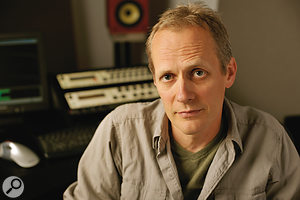
Craig Silvey at The Garden studio.

Craig Silvey at The Garden studio.Craig Silvey at The Garden studio.Photo: Lucy Williams


Engineer and producer Craig Silvey has been known to mix singles, such as Gabrielle's mega‑hit 'Rise' in 2000, but his mainstay is working on entire albums. His discography features names like REM, Santana, Ray Davies, Nine Inch Nails, Linda Ronstadt, Aaron Neville, Pearl Jam, the Coral, Portishead, the Magic Numbers and New Young Pony Club, along with classical acts such as the Kronos Quartet and John Adams. The most recent highlight is Arcade Fire's The Suburbs, an album that has made number one in the band's native Canada, the US and the UK, as well as wowing critics worldwide. Although the band's three albums, Funeral (2004), Neon Bible (2007) and now The Suburbs, have been increasingly successful, their singles continue to barely register in the charts. The new album's title track and first single reached number 94 in Canada and didn't even chart in the UK and the US, while the UK single 'We Used To Wait' only managed a measly 75th place. In short, Arcade Fire are that increasingly rare, old‑fashioned thing: an album act.

Analogue Freak

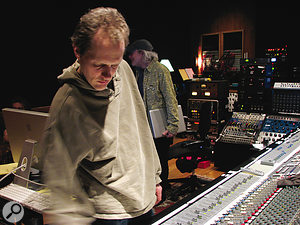
The Garden is based around a vintage Neve 8026 desk.

The Garden is based around a vintage Neve 8026 desk.The Garden is based around a vintage Neve 8026 desk.


"I can't stand the sound of MP3s,” declares Silvey, with some vehemence, and he's not a fan of digital audio in general, even the HD variety. He currently works from a studio in East London called The Garden, owned by The The's Matt Johnson, and it's filled to the brim with Silvey's antique and vintage gear, which he has collected over two decades. Pride of place goes to his 40‑input Neve 8026, loaded with 1084 and 1076 modules. There's also a Neve BCM10 sidecar, a Studer A80 24‑track, and a wealth of outboard, including EQs by Helios, John Hardy and Calrec, compressors such as the Thermionic Culture Phoenix, Universal Audio 1176 and Urei LA4A, mic preamps by Telefunken (V76, V72), Summit and Tube‑Tech, a whole posse of vintage mics, and his beloved Mastering Labs monitors, the legendary ML10s. Aptly, the place is billed by the studio's promoters Miloco as a "vintage tracking heaven”.


"Yes, I'm an analogue freak,” admits Silvey. "There is a definite sonic advantage that you can hear almost immediately when you use it. To my ears, the difference between doing my mixes in Pro Tools and then bringing them out on the desk is astronomical. The summing is very different. With regard to the digital method, we are all control freaks, and if you're given more control, you become more obsessive about it. The digital tools are great, but the key is to only use them when you need them, instead of all the time. Just because you can does not mean that you should. I prefer to record to analogue tape, when I have the time and the budget. I did it recently for the first time in about nine months, and I'd forgotten how great it sounds. But these days everybody wants to be able to do multiple takes and edits, and when you do 50 takes, you can't keep them all when you work on analogue. So you quickly end up in the world of Pro Tools. I generally use it as a glorified tape machine. As long as you keep your Pro Tools faders to zero and you don't do any summing inside, it sounds fine.”


Silvey puts his love of analogue technology down to his formative days as an engineer. Born 41 years ago in the Bay Area of California, he learned to play trumpet and piano in his pre‑teens. As a teenager, he discovered rock & roll and became fascinated by recording and production. On leaving high school, he worked in local studios and also did an internship with George Massenburg, who a couple of years later got the young man a job at George Lucas' Skywalker Sound scoring studio. Silvey quickly moved up the ranks to become chief engineer there from 1992‑95, during which time he worked with a number of great producers, among them Massenburg, Phil Ramone and Walter Afanasieff. According to Silvey, this meant that a lot of his education came from "guys who had had their training in the '60s and '70s”. He became a self‑declared "obsessive gear nut”, and after leaving Skywalker, put the extensive collection of gear he had gathered to good use in a studio in San Francisco which he called Toast, and which continued until 2002. However, by the late '90s Silvey had fallen in love with a British woman and with British music ("there seemed to be more creativity among British musicians and bands”), and relocated to London ("I am some kind of weird hybrid now: half‑American, half‑British”). For many of his London years, Silvey worked out of Ray Davies' Konk Studios, but as of 2009, The Garden is his studio home, and he's filled it to the brim with the gear he's collected over the years.

Arcade Games

Most of Craig Silvey's sound shaping is done using the outboard gear he's collected over many years.

Most of Craig Silvey's sound shaping is done using the outboard gear he's collected over many years.Most of Craig Silvey's sound shaping is done using the outboard gear he's collected over many years.


Apparently, Arcade Fire and Silvey are kindred spirits in their love of analogue and old‑fashioned recording methods. The first contact between the two camps was made in December 2009, when engineer Mark Lawson sent a 96/24 Pro Tools file of 'The Suburbs' across the Atlantic, with the request for Silvey to have a go at mixing it. The connection was made because of the English‑American's mix of Portishead's Third in 2008, an album widely admired by musicians, including the members of Arcade Fire. Immediately after completing work on Third, Silvey and Portishead's Geoff Barrow co‑produced The Horrors' second album Primary Colours (2009), which also had a strong impact among musicians. Arcade Fire had been working on what was to become The Suburbs since the beginning of 2009, together with Lawson and co‑producer Markus Dravs, and, after several months' work, felt that they needed a fresh pair of ears to make sense of what they had and draw the whole project together.


Silvey: "When they sent me 'The Suburbs', there were hardly any instructions, apart from 'don't do this' and 'don't do that' from a technical perspective. They simply wanted to see what I would do with it. The session was very well‑organised and named, and everything had its place. The tracks had been meticulously recorded and cleaned up: they could have given me two 24‑track multitracks. There was none of the mess that I sometimes encounter with Pro Tools Sessions, with crazy routing, inconsistent levels, dozens of plug‑ins that leave me having to decide which ones are useful and which not, and so on. Mixing 'The Suburbs' was therefore relatively straightforward. They had envisioned that I mix the entire album remotely, from The Garden, but they then decided that they wanted everyone to be together. So I had just set up my studio and gotten comfortable, and then in February this year I went to Montreal where I spent three months mixing the rest of the album, and also tweaked my mix of 'The Suburbs'.


"I did all this in a place called Studio Frisson, which also has an old Neve console, an 8034‑8014, with some interesting custom routing. Like me, the guy that owns it is an obsessive gear nut. Frisson is in many ways an identical copy of The Garden; their mind-set and my mind-set are very akin. The band had been doing a lot of recording at Frisson, but had also often been recording at their houses and at their studio in a village church an hour outside of Montreal. Most of the backing tracks were recorded to an [Otari] MTR90 24‑track I think, often through an amazing valve desk called the McCurdy AU300, which was Frisson's and which the band rented and have since bought. They wanted to record the album on one tape recorder with everyone in the room, so, for instance, people are clapping live into the overhead mics with the drums playing. They did not want the sonic elements to become too precise and too controlled, instead they wanted some wildness. It's a bit like listening to records by Sly Stone and the like, where you really can hear that they had fun while recording.”

Perspective

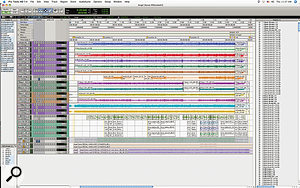
A composite screen capture showing the entire Pro Tools Session for 'The Suburbs'.

A composite screen capture showing the entire Pro Tools Session for 'The Suburbs'.A composite screen capture showing the entire Pro Tools Session for 'The Suburbs'.


According to Silvey, the use of the single tape recorder and the McCurdy desk was part of a number of restrictions the band and the production team had imposed on their way of working. Despite this, the multitracks for The Suburbs more often than not contained 60‑plus tracks for each song, with the overview of what was recorded, and why, sometimes in danger of being lost. Silvey: "It was their third record, and given the success of the first two, they now had the time and the financial means to try anything and everything. They needed to do that, but they also knew that this could be a recipe for disaster. This was the main reason for putting limitations on the way they recorded, and then the rest of the time they worked out how to get around these limitations. It was also, for example, why we mixed at Frisson, rather than at Celine Dion's studio in Montreal, which has a 96‑input SSL that would have, in many ways, been much easier, particularly as the Neve at Frisson doesn't have workable automation. Working at Celine Dion's studio would have given us more options, but we didn't need these, we needed restrictions.


"There were several reasons why many of the Sessions turned out to be so huge. There are seven musicians in the band, and everybody is really talented and everybody plays different instruments, and things were being recorded in several different ways, often simultaneously, and they often used several mics to record each part. It was tough keeping an overview of everything that was recorded, and Mark Lawson would have a thousand spreadsheets going about what was done when and by whom and why. Many Sessions were so elaborate that he'd need two or three days preparation for each song that I was going to mix, to compile everything and load it into one Pro Tools file. As talented as everyone was, including Mark and Markus and the other engineers that were involved, after having been involved in it for so long, by the time they approached me I think they really needed someone with an outside perspective.


"Besides mixing, my role was to make sense of all the stuff they had. I helped decide which things were necessary and which things not. I then would do a preliminary mix of each song, because they needed to hear the tracks in some kind of shape to be able to decide where some of the things they had recorded were supposed to go, or whether they were perhaps not needed after all. There definitely was an element of trying to find space in the mix for everything that was recorded. I not only mixed on the Neve at Frisson, but also the McCurdy, and at times I also had a Neve BCM10 sidecar and a Quad Eight going! They were all patched up and used in different ways. Mark Lawson was in the live space of the studio and could help out whenever necessary. At one point we had six engineers working on a mix! Because we didn't have automation, I did stems of the drums, the bass, the guitars, and so on for each song after each first mix pass. In some cases I ended up with 30 stems per song. The band wanted to be able to do a recall of each song after my initial mix pass, and you can't do a complete recall on an old Neve. The second mix would consist of maybe 80‑90 percent stems from the first mix and the rest was redone. For most songs, my original mixes were very close, and the second mix was usually a matter of level changes, rather than more radical changes.”

Mixing In Waves

With seven members playing a battery of different and sometimes obscure instruments, it's not surprising that Arcade Fire are a challenging band to record and mix.

With seven members playing a battery of different and sometimes obscure instruments, it's not surprising that Arcade Fire are a challenging band to record and mix.With seven members playing a battery of different and sometimes obscure instruments, it's not surprising that Arcade Fire are a challenging band to record and mix.Photo: Rama


Given that the Session of 'The Suburbs' was clean, well‑recorded and well‑organised, Silvey could go straight into mixing the song on his 40‑input Neve 8026. With the Session consisting of 50‑odd tracks, the input restrictions on the Neve meant that some prior organisation was necessary. Silvey: "I had to do some grouping in Pro Tools. But the Neve also has a 24‑channel monitor section, which I used for effect returns and any tracks that spilled over. I also used a Neve BCM10 sidecar. I also had a fair amount of hardware outboard inserts in Pro Tools. A signal would go out of Pro Tools to a compressor, come back into Pro Tools and then come again on another set of outputs, which I could automate in Pro Tools. I also did some level automation in Pro Tools — using a Pro Control, I can't stand doing moves while looking at a computer screen — but overall that was minimal, so most of the mix was a live performance on the desk. I find that if I can set up a good general balance without reverting to automation, or without having to move the faders, it means that the mix is already in a good place, because things are not sitting on top of each other. That really comes from the old school of thinking about mixing. I try to make my mixes as wide and as deep and as tall as I can, really place things in 3D, with nothing sitting on top of each other.


"With regard to my mixing method, I mix in waves. The first time I speed through a mix, trying to get a sense of what's there and a direction for the song. I then will start on the drums, but again, I won't spend a lot of time on them. I may get them to 50 percent of where I want them, and then quickly move on the bass, and then the guitars, and then the keyboards, and then the vocal, and so on. I'll then listen to the whole and do individual tweaks. I'll then go back to the drums in solo, the bass in solo, and so on, and I may repeat that process two or three times, and from that point onwards I'll listen only to the complete mix. I obviously prefer to use outboard, but there are two plug‑ins that I couldn't live without: the Massenburg Designworks EQ and [Audio Ease] Altiverb. You can see the Massenburg in the 'Suburbs' Session as MD3 and MD5 on various tracks. I use it for fine‑tuning specific frequencies, whereas outboard or Neve desk EQ is for sweetening and colouring the sound. The '662' and '632' on Aux 1 and Aux 2 are Altiverb, one being a spring reverb, the other Cello Echo Chamber 2, and the [Line 6] Echo Farm is a pre‑delay for the Cello echo chamber, which was my main reverb for this song. The pre‑delay is half mixed‑in, so some of the signals go straight to Altiverb and some of it is being delayed. I'm a big fan of Altiverb. When I heard it the first time I thought, 'Oh my god, that sounds exactly like the real thing.' It's brilliant.”


Arcade Fire's sound tends to be awash with reverb, though less so on The Suburbs than on their previous two albums, and singer Win Butler's vocals are mixed relatively low. Together, these qualities mean that Arcade Fire's recordings tend to be high on atmosphere but low on definition. Silvey explains: "The reverb has to do with the way they record things. Many of their guitars have a lot of amp spring reverb on them, for instance, and they also tend to use many room mics. Also, their block harmonies suit being big and reverb‑y, so there's an obvious gravitational pull towards using reverb. I also found when I was mixing that reverb helped me to separate things. Win is very particular about the way he wants his lead vocal to sound. He likes to have a slap echo on it, and he doesn't like other things. His voice being mixed far in the back is also mostly intentional. He's conscious of the fact that Arcade Fire is a band, and not him fronting a band. In bands, it's easy for it to become all about the singer, but Win really does not want it to be like that, so it's perhaps a subconscious thing that he likes his vocals pulled back a bit. I personally also gravitate towards vocals sitting a little bit more as part of a powerful sounding track, rather than them being up‑front and the entire focus being on them.”


Drums: GML 8900, Audio Ease Altiverb, Neve EQ.


"There are 13 tracks of drums, and you can see that there are two drum kits. The orange tracks are Jeremy [Gara] and the pink ones Régine [Chassange]. They often have two kits in one song, with one drummer holding down the groove and the other, in this case Régine, playing accents and fills. Her drumming was really effective in progressing the song. It's quite a long song but you don't realise it. A lot of that comes from Régine lifting the song a little each time, without you noticing it or focusing on it. I will usually group the drums and send them to a compressor, generally the GML 8900, which is an unbelievable compressor on drums, it really allows them to breathe while also making the groove more pulsating. It's not the most intuitive piece of kit, but once you learn how to use it, it's really controllable. I'll have a clean and a compressed drum path coming up on the desk, and I'll usually feed all drums through both paths, though things like cymbals may only go through the clean path if they sound too harsh via the compressor. Only if I find that the kick or the snare needs different or added compression for more punch will I put these individually through a compressor, like the Dbx 160X. I don't think I used the Dbx on this track, though. I did mix in some Altiverb spring reverb on the snares, with the mono spring only on the left, to make it sound starker. I also used some desk EQ, though not a lot. The claps would have been treated with the drums. They're not as distinguishable in this track as they normally are with Arcade Fire, they're just a texture.”


Keys & bass: Urei LA4 & LA2A, Roland RE501, Thermionic Culture Culture Vulture, Universal Audio 1176, Neve EQ.


"Under the drum tracks are four synth tracks, which are actually three parts: an [Analogue Solutions] Vostok, a [Korg] MS20 and a synth played by Will Butler that was also re‑amped. All these parts had their moments where they came more to the fore. I didn't do anything special on them, perhaps a little reverb and the MS20 had an L4A on it because it was a little too dynamic. There are three bass tracks, DI, amp and reamp. The reamp was already there, but I didn't use it. I felt that this track had echoes of Neil Young's 'Till The Morning Comes', and I took that as a bit of inspiration with my direction. I put an LA2A on the bass, to make sure the picked bass didn't poke out too much, as well as a slap delay from the Roland 501 and some distortion for some crunch, so it didn't sound too clean. I probably used the Roland 501 space echo for the slap and also the Thermionic Culture Vulture for the distortion. Further down the screen there's a piano track, which was the core of the song. It's a stereo part that I put through two 1176s, and I used some board EQ. I felt that the piano needed to stay dry, so it doesn't have reverb.”


Guitars: Universal Audio 1176, Neve EQ, Ursa Major Space Station, Helios EQ, Lexicon Super Prime Time, Ibanez AD202.


"The nylon guitar is another core track, which had pretty heavy compression on it with an 1176, plus board EQ. To make it jump out a little more I also used an Ursa Major Space Station, on an early reflections program. When you don't put too much feedback on, it doesn't sound like reverb or delay but it does make it sort of stand out. With regards to the other guitars, there are two sets of guitars, named 'A' and 'B', while 'R' stands for Richard [Reed Parry], just to identify who played. Those names are given by Mark Lawson. The 'A' and the 'B' guitars are the same part, played twice, and then each recorded on four different tracks: DI, two amps, and a room mic. I turned off the room tracks, because I felt they weren't needed, and then balanced the other three tracks internally in Pro Tools. I bussed guitar 'A' to track 'Master 1' and 'B' to 'Master 2', and they go to the desk and are sent to my Helios EQ modules and 1176 compressors. The guitars were well recorded and didn't need much treatment, just a little more front, and the Helios modules are great for that. You can crank 2k with 15dB on them and the guitar will sound like on a Led Zeppelin record!


"The guitars had loads of spring reverb on them already, but I added some Lexicon Super Prime Time for some more spatialising, as well as two delays. What's great about the Prime Time is that you can put super‑fast modulation on it, like a 100x speed thing, which makes the modulation so fast that you can't hear it, but it adds a beautiful shimmery blur which I also used on the strings. Finally, there are six tracks of Ebow guitar, overdubbed to build them up to a chord and create a drone. They came up on one fader on the desk, on which I used some Ibanez AD202 delay, with the original signal panned to one side and the delay to the other, to make the guitar sound like it was really wide left and right but also perceived to be in the middle, without it actually being in the middle. The AD202 is an analogue delay with some really interesting modulation. The sonic quality of the AD202 is pretty lo‑fi; there's no top end, so you don't hear it as a delay.”


Strings: Thermionic Culture Phoenix, Lexicon Super Prime Time, Roland RE501.


"I created an internal balance for the strings in Pro Tools, and did not use the room mics. I sent that balance to my BCM10 sidecar, where they were submixed before going to my Thermionic Culture Phoenix compressor, with a very minimal setting. After they went through the Phoenix they came back into Pro Tools, under Aux 3, so I could automate them, and on its return I put some of that Prime Time shimmer. I also put the strings through the Roland 501 Chorus Echo, slightly wobbling the tape speed to make the strings sound a little bit like they were from an old film.”


Vocals: Empirical Labs Distressor, Tube‑Tech EQP1A, Roland RE501, AMS delay.


"There's one vocal track and a background vocal track for the choruses. I used a Distressor on the vocals and the Tube Tech version of the Pultec EQP1A. I take out as much low end and add as much air as I can, trying not to make the vocals too thin or give them too much sibilance. Sometimes Win sings really quietly, and if you compress him you get a fair amount of mouth noise and sibilance. I'm not a fan of de‑essers, however, as they always seem to undo what I did with the EQ, so instead I usually find the 's' sounds in Pro Tools and notch them out by automating a dip in volume where they occur, so short you won't even hear it. It's the only time I do automation with a mouse. That seems to work better than de‑essing. In addition, there's the slap delay from the Roland 501 and two short delays from an AMS with a little pitch‑shift, one up and one down, which thickened the vocals, like a doubler. It was explained to me as the Phil Collins drum delay, but it works great on vocals. You can see that I was adding more 501 and dropping out the AMS in the choruses. All these were treatments on the lead vocal. On the backing vocal I would only have had a little bit of reverb and stereo delay, and I had it panned.”

Mixdown


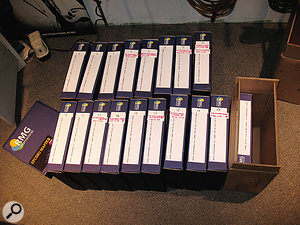
"At the bottom of the screen, you can see the first of my stems, which were used to tweak the mix later in Montreal. There are probably about 15 stems in total. The stereo mix went through an SSL compressor and a GML EQ, and then via a Lavry A-D converter back into Pro Tools. Because we were doing stems for a possible second mix, mixing to tape wasn't very practical. We did want to have the ethos of a very physical analogue recording, so together with George Marino, the mastering engineer, we came up with the idea of printing all mixes to vinyl and then going straight to CD. In fact, each song had its own 12‑inch, 45rpm acetate, so we could get all the frequency information on them, while the acetate was played back only once, straight back into the computer, so the CD is based on the highest possible quality vinyl recording in mastering. Obviously, it was not cheap — we burned through a lot of acetate! But we had mastered 'The Suburbs' digitally as well, just like you would do for a CD, and when we compared the file that had gone via the acetate with the Pro Tools‑only file, the difference was enormous. Everybody was like 'Oh my god, this is amazing!' and so we decided to master the whole album like that.” .

'The Suburbs'

Craig Silvey: Mixing Arcade Fire 'The Suburbs'

Written by: Arcade Fire


Producer: Arcade Fire and Markus Dravs Craig Silvey: Mixing Arcade Fire 'The Suburbs'

'We Used To Wait': Mixing In Montreal

This screenshot showing part of the Session for 'We Used To Wait' illustrates how things had changed by the end of the mixing sessions in Montreal.This screenshot showing part of the Session for 'We Used To Wait' illustrates how things had changed by the end of the mixing sessions in Montreal.


As Craig Silvey explains in the main article, the title track was the only song from The Suburbs that was mixed almost entirely in London. The rest was mixed by him at Studio Frisson in Montreal, on a Neve 8034‑8014 desk, sometimes with the help of a Neve sidecar and a McCurdy desk. To give some insight into the proceedings in Montreal, Silvey elaborates a little on his mix of the second, UK‑only, single from the album, 'We Used To Wait'.


"That track was a big challenge to mix, because it was three songs into one. There were a few songs like that, 'Ready To Start' being another one. 'We Used To Wait' had three drum kits, each with a different sound, and they were not neatly separated; instead they ran into each other, so one kit might do half of a chorus, and another the other half of that chorus. Given the limitations of the mix scenario — desks with limited inputs and no automation — we had to print stems and mix in sections. It was the old‑school method where you mix the verse, and then the chorus, and then the next verse, and so on, and finally you edit it all together. An added challenge was that the band wanted the verses to be really organic, kind of Neil Young‑like, and the choruses to have a Depeche Mode‑like explosiveness, and trying to get those shifts in a non‑automated world was not easy. It took a lot of faith and vision to make it work.”

This screenshot showing part of the Session for 'We Used To Wait' illustrates how things had changed by the end of the mixing sessions in Montreal.

The screenshots for 'We Used To Wait' are also markedly different, much more complex and less transparent than those for 'The Suburbs'. The colour‑coding is much less clear, for instance, while many tracks are greyed out, and with 30‑plus tracks of drums in blue and purple, it's difficult to see what's happening. "By the time we got to this track we were two‑thirds into mixing the album,” explains Silvey, "and we were probably just trying to survive, and I didn't have time to add all the nomenclature and colouring. The greyed‑out stuff was muted, of course, in many cases because we didn't have enough channels on the desks to play everything back. There are also quite a lot more plug‑ins on this track. For instance, there are a lot of [Waves] L2 limiters. The drums in the choruses had these gated rooms, and the room they had recorded in wasn't the most explosive‑sounding, so the L2 helped to make things super‑loud. It was followed by a gate that was triggered by the snare drum.”    


Tuesday, June 9, 2015

Robert Plant 'Angel Dance'

Inside Track | Secrets Of The Mix Engineers

People + Opinion : Artists / Engineers / Producers / Programmers


Thirty years after Led Zeppelin ended, Robert Plant has reached a second career high. His latest hit album was tracked and mixed by Mike Poole, using a mouth‑watering selection of vintage equipment.


Paul Tingen

Mike Poole.

Mike Poole.Mike Poole.


The million‑dollar question for every ageing rock dinosaur is how to avoid going the way of the dodo, or, at the very least, Rod Stewart. The question has been answered in various ways, in most cases by pigheadedly refusing to adapt to age and changing times, and simply carrying on as if everything is as it ever was. There is another strategy, however, which may be described as growing old gracefully. One of its main proponents has been the now 62‑year old Robert Plant.


While it greatly frustrates Led Zeppelin fans, it has done no harm to Plant's credibility that he's steadfastly refused multi‑million dollar offers to tour with his former band. In addition, during his post‑Zep solo career Plant has repeatedly managed to defy expectations and explore different and unanticipated musical directions. Plant's upward career path started with an album of bluesy rock covers, Dreamland (2002), followed by a mixture of rock and world music, The Mighty Rearranger (2005). Only moderately successful from a commercial point of view, both albums were critically lauded, and each garnered two Grammy Award nominations.


The roof blew off in 2007 with Raising Sand, a duet album with bluegrass singer Alison Krauss. An exploration of Nashville‑influenced Americana produced by T‑Bone Burnett, the album won a staggering five Grammy Awards, including for Album of the Year, went platinum in both the US and the UK, and sold three million worldwide. Three years later, Plant revived the name of the first band he played in, the Band Of Joy, a '60s psychedelic folk outfit that also featured Zeppelin drummer John Bonham. But rather than a harking back to that long-distant past, Plant's new album, Band Of Joy, is a continuation of Raising Sand, in that it also explores Americana with Nashville overtones. It again features a well‑known female vocalist, Patty Griffin — although in a much less prominent role than Krauss's on Raising Sand. There's a change in the production team as well, with Burnett making way for country guitarist, singer‑songwriter and producer Buddy Miller, who co‑produced Band Of Joy with Plant, while the recording and mixing processes were helmed by Mike Poole.

'Angel Dance'


Robert Plant 'Angel Dance'Written by David Hidalgo and Louie PerezProduced by Robert Plant and Buddy Miller

Atmosphere and Character


Robert Plant 'Angel Dance'Band Of Joy had, a month after its September release, reached number three in the UK and five in the US hit parades, and seems destined to achieve similar commercial success to Raising Sand. Billed in a press release as "a timeless plunge into authentic Americana”, Band Of Joy contains country, gospel and soul covers from a few decades ago and before, but also more current songs by Los Lobos ('Angel Dance'), Richard Thompson ('House Of Cards'), Townes van Zandt ('Harm's Swift Way'), and two atmospheric epics by the Minnesota 'slowcore' band Low ('Silver Rider' and 'Monkey'). Band Of Joy is also more experimental sonically than its predecessor, though both were recorded in Nashville.


Engineer and mixer Mike Poole is a Nashville native who was planning to study commercial photography at Middle Tennessee State University in the early '80s, encountered "one of the first recording programmes in the country” there, and promptly decided that this was his future. He worked in various studios and became independent around 1990. "I went one step up on the autonomy ladder, and took a corresponding pay cut,” he laughs. Over the last 25 years, Poole has become a familiar and highly respected face in Nashville's studios, clocking up credits such as John Prine, Martina McBride, Patty Griffin, and many, many more. Poole got the gig for the Band Of Joy recordings via Buddy Miller, whom he regularly helps out whenever the guitarist doesn't want to do the engineering himself.


According to Poole, the only pre‑production that took place was the song selection and choice of musicians, with the Band Of Joy becoming Miller on guitars and vocals, Darrell Scott on mandolin, guitar, accordion, pedal, lap steel and banjo, Byron House on bass, Marco Giovino on drums, and Patty Griffin on vocals. Bekka Bramlett also contributed backing vocals to two songs on the album. Poole: "Buddy and Robert talked a lot about what the album was going to be, but did not prepare many arrangements before we went into the studio. The musicians and I got some discs with songs before we went in, and there were some emails and conversations, so everybody knew what the influences and some of the potential songs were, and beyond that Robert and Buddy only made sure that we all went in with a similar mindset. The arrangements were worked out in the studio, and if they worked, great, and if there was no magic, we simply moved on. The songs were mostly recorded live in the studio, with very few overdubs or edits. Usually, we did at most two or three takes of each song. Most of what we were doing was about creating the atmosphere and character for the songs, and not sweating over details.


"Most of the album was recorded at Woodland Sound, which is the studio of Gillian Welch and Dave Rawlings. It had been a commercial studio until about 10 years ago, when they purchased it. They have since used it as their private facility. We knew them and we wanted a place that was both technically appropriate and private, and they happened not to be working on their own stuff at the time, so they were gracious enough to let us use it. We went in on the first of December 2009, spent a couple of weeks recording, and then came back in at the beginning of February for another four days of tracking and a few overdubs. From there we went straight into mixing in studio A at House of Blues Studios, Nashville. Because of band members' schedules, I had to do some overdubs while I was mixing. I spent two weeks mixing, and the whole album was finished by mid‑February, except for one track on which we later altered a vocal and I tidied up a couple of things.”


Welch and Rawlings are well‑known purveyors of high‑quality Americana and lovers of analogue equipment, and it is to be expected that their Woodland Sound Studio is full of the vintage, weird and wonderful. "Yeah,” Poole confirms, "the studio is full of lovely old vintage and ribbon mics, Telefunken and Neve preamps, Pultec EQs, Fairchild compressors and so on. They also have an old Neve 16‑channel, four‑bus broadcast desk, plus an small API sidecar. Buddy and I also brought a lot of our own gear. In the end, I only used their Neve desk for monitoring. Instead, all our input channels were mics going into discrete mic pres, then via compression or EQ if needed, and then straight into a 16‑track Studer A800 tape machine.”

Limitations

Mike Poole at House of Blues Studio, where Band Of Joy was mixed. Producer and guitarist Buddy Miller is in the background.

Mike Poole at House of Blues Studio, where Band Of Joy was mixed. Producer and guitarist Buddy Miller is in the background.Mike Poole at House of Blues Studio, where Band Of Joy was mixed. Producer and guitarist Buddy Miller is in the background.


And so, predictably perhaps, Plant, Miller and Poole went for the classic record‑live‑into‑a tape machine approach that's been at the heart of Americana for 60‑odd years. The famous American producer Bill Bottrell once opined to this writer that Americana will soon bite the dust, as it's wedded to the analogue recording medium, while Pro Tools is moving music to a much more urban and synthetic place.


"I would agree with Bottrell in terms of the difference between the sonics of analogue and digital,” says Poole. "There are genres for which DAWs work wonderfully, but I don't think that they are ideal yet for this kind of music. One of the reasons Buddy and I like working with each other is that we both like going to the same places sonically, so it's not a battle to try to get across what each of us wants, and we knew that the Band Of Joy album would be much more suited to analogue from a sonic perspective. One of the arguments of proponents of digital is that the playback sounds exactly like the input. That may be true, but with analogue tape the playback often sounds better than the input. I prefer to go with the medium that makes things sound better!


"Robert also has a preference for working in the analogue domain: it's where he's from, and it sounds familiar and attractive to him. But most of all I think he likes working with the limitations of the medium, the fact that you can't easily slide tracks backwards and forwards in time and you might have to punch in a whole bar rather than a single note. Plus there's the vibe and approach that came from limiting ourselves to 16 initial tracks. This meant that we had to make decisions early and we couldn't mess around with laying down many different drum scenarios, or whatever, which you tend to do when you have tons of available tracks. It's easy to get lost in a world of endless options.


"I don't see a Doomsday scenario like Bottrell does, however. For example, DAWs encourage you to work with a constant tempo to facilitate editing, but it is quite easy not to have a click going and to use it as you would a tape recorder. The trick is to remember that and not allow yourself to be tied to the ways in which the software tries to get you to work — don't let the tool overly influence the way you work. And I think that there will always be younger people coming along that will be inspired by the music from the past and that will adapt DAWs to work for them, rather than allow the computerised, linear way of looking at and organising music to become a stumbling block. They will just hit Record and Play and will be able to work beyond what the medium expects them to do.”

Failsafe


Despite Poole's obvious love for analogue, he also used Pro Tools for the Band Of Joy sessions. "I use Pro Tools all the time, because it has things that are incredibly usable. We can now do things that we could never do in the past. For the Band Of Joy project, we didn't only track to 16‑track analogue, but we also went straight out of the Studer into a Pro Tools HD system, via an Apogee AD16. The Studer would have been set on input while recording, so the Pro Tools was receiving only the coloration of the Studer's transformers — the sound was not coming off tape — and I would be monitoring off Pro Tools.

The entire Pro Tools Session for 'Angel Dance'. None of the plug‑ins were used in the final mix, and the edits on Robert Plant's vocal track (coloured green, about two‑thirds of the way down) were mainly to tackle sibilance issues. At the bottom you can see mixes were recorded back into Pro Tools from the SSL desk.

"There were two different reasons for working like this. One was that we knew that we probably would need extra tracks for overdubbing and editing, and so we'd end up on Pro Tools anyway and would be mixing off Pro Tools. Monitoring through the system prevented any later surprises about the sound. We also didn't do any editing with razor blades — editing is so much easier in a DAW. I recorded to two‑inch RMG 900 tape, at 30ips. We listened a couple of times to compare the tape and the digital versions, but we all liked the tape version better. So when we felt we had a good take and that we wanted to do an edit or just move onto the next song, I immediately transferred the take to Pro Tools, at 24/96. Once we had the analogue colour, it was just a matter of being pragmatic to work entirely in Tools from then on. If an overdub needed that analogue colour, I'd fly it over to the tape machine and then back into Tools. It's not as ideal as having it on tape to begin with, but it gets you part of the way there, sonically. Apart from a few backing vocal overdubs that I didn't fly back, almost everything on the album has touched analogue tape.The entire Pro Tools Session for 'Angel Dance'. None of the plug‑ins were used in the final mix, and the edits on Robert Plant's vocal track (coloured green, about two‑thirds of the way down) were mainly to tackle sibilance issues. At the bottom you can see mixes were recorded back into Pro Tools from the SSL desk. The entire Pro Tools Session for 'Angel Dance'. None of the plug‑ins were used in the final mix, and the edits on Robert Plant's vocal track (coloured green, about two‑thirds of the way down) were mainly to tackle sibilance issues. At the bottom you can see mixes were recorded back into Pro Tools from the SSL desk.


"The other reason for our recording setup was to be able to quickly do another take whenever needed. With Pro Tools I don't need to worry about how long the tape reel is, so I had it in record pretty much at all times. If we had reached the end of a reel, I could keep Pro Tools moving while rewinding or changing the tape, just in case the band was ready to record. One of the things that always happens in recording studios is that some magic is going on and the musicians look up at the control room with a look on their faces saying, 'Are you recording this?' I want to always be able to put my thumb up and indicate, 'We are rolling.' The musicians should never have to wait for the engineer. The sound of the format matters a little bit, but not as much as actually being able to be in record at the right time and capturing everything that's happening. I tried to roll the Studer for the actual takes, and Pro Tools was purely my failsafe that allowed me to keep things rolling at all times, just in case.


"With the Pro Tools system always recording, or set to record, the analogue equipment was my main focus during recording. I find that things are more intuitive for me when I'm working with analogue hardware. When I'm standing at a desk, my hands will reach intuitively for the EQ, and without even thinking about it I may at the same time do a fader move with my other hand. I can do all that instantly and purely on feel. By contrast, with the digital devices, even with big controllers, I find I need to think in a very linear fashion. It's very difficult to ride and tweak things at the same time, and you therefore end up putting small tweaks off. Sometimes you forget about them, or you may decide you don't have to do it anyway. So it really affects the way I work, and I think that of other people as well. Software forces you to interact with it on its own terms so much more than hardware does. It's like the old‑style car radios: you could reach over and press big buttons and turn a big knob and dial in the station you wanted without having to look at the device. But with digital radios you need to look down and look for feedback from the device with every move you make. Your options are greater, but you have to pay much more attention, and this can distract you from what you should be doing, whether driving or listening to the music.”

Non Standard

Initial live takes were recorded to 16‑track, two‑inch tape, before being transferred to Pro Tools for overdubs and mixing.

Initial live takes were recorded to 16‑track, two‑inch tape, before being transferred to Pro Tools for overdubs and mixing.Initial live takes were recorded to 16‑track, two‑inch tape, before being transferred to Pro Tools for overdubs and mixing.


Homing in on the analogue equipment that was his focus at Woodland Sound, Poole elaborated on the recording stage of the album's opener and first single, 'Angel Dance'. Was his setup similar for all songs? Poole: "When Buddy and I work together it can be pretty free‑form, and it's not uncommon for us to use different setups depending on what the instruments are, for example whether they're acoustic or not, and where the musicians need to be to give the best performance. By contrast, when I'm recording a project that I'm not going to mix, or for which the direction isn't quite clear yet, perhaps because the corporate side wants to have its input later on, I would normally have a fairly standard way of recording. With the Band Of Joy project, however, I felt free to vary the recording setup a little bit, as was appropriate for each song.


"We had a basic setup that we thought would be good for the bulk of the recording, which was that we had the drums and the bass in the main live room. Buddy was also in that room, but his guitar amp was isolated in another room, and Robert and Darrell had their own booths, in Darrell's case because he was mostly playing acoustic instruments. Everybody could see each other, everybody could come into the main room if they wanted; I remember we cut two songs with everyone except Robert in a circle, one of them being 'Central Two‑O‑Nine'. For me, it was matter of constantly adapting to what was happening, and sometimes I suddenly realised that people were going to do a take right where they had decided to sit down, which meant that I had to adapt my setup very quickly. In general, I set up quite a number of microphones, but did not use them all on each song. I also didn't have a standard drum-mic setup, because Marco had a non‑standard kit and played non‑standard parts. The room with Buddy's amp was large enough to have a room mic as well as a close mic.”


Poole was organised enough for this interview to supply a copy of his assistant Gordon Hammond's input chain sheet, reproduced on the left. Rather than explain each detail, Poole elaborated on some of the less usual aspects of his setup, for instance the Avantone BV1 on Robert Plant's vocals, which went through a Telefunken V76 and then an Inner Tube Audio Atomic Squeezebox compressor. Poole: "We tried a few mics on Robert, but the Avantone was definitely the best‑sounding. It gave us the picture that wanted of his vocals. I had only used that mic a little bit before, and it has definitely become a go‑to mic for me. It is very good at tracking sibilance, although after the vocal had gone through a compressor or two by the time I mixed, I had to do quite a bit of detailed work on 'esses' and mouth noises and so on. The Atomic Squeezebox is also fairly non‑standard, but it is a really good compressor. It reminds me a bit of the Summit Audio stereo compressor; it has the same feel but is a little bit more transparent. For the sound image we were after it was great. It also allowed me to put a highly dynamic performance on tape without the compression being audible. I always monitored through an [Urei] 1178, which was part of the mix path, and which gave the coloration we wanted to hear.


"The RCA speaker on the drums is a tiny speaker from before the days of computers, probably from a small cassette deck or reel‑to‑reel deck. I would find a spot in front of the drums where there was a pretty good balance and I'd place it there. I used it to get a highly compressed, pretty nasty drum sound. I don't think I used a whole lot of it in the mix on 'Angel Dance'. The Neumann M147 did a great job on the bass drum, and the two RCA KU2A mics that I used as room mics are old ribbon soundstage mics known as 'the Skunk', because they have a large, six or seven‑inch, black, ball‑like windscreen with a white stripe down the back side, just like the stripe on a skunk. These were Gillian and David's mics, and they worked great on the room at Woodland, which does not have a lot of ambience, but the RCAs gave me a little bit of a different perspective than the overheads. The RCA MI6203 on Darrell's amp is a really mid‑rangey mic, which worked great for this song. Buddy's amp had a Royer R121 going into a Chandler Germanium mic pre, which has a feedback knob that can be used as a bass tone control with the gain setting that I use. The Germanium is somewhat related to the Neve 1055; the circuits are similar, even though it doesn't quite handle the same.


"The Avantone CV12 on Darrell's and Robert's backing vocals is a sort of AKG C12‑ish mic. It's a little bright for vocals, to my ears, but the BVs in this song were 'ahs' that needed some extra air, and I rolled the bottom end off anyway. I've also used that mic on upright bass and drums. You get a lot of bang for the buck with these Avantone mics! The RFT AK47 on Bekka's BVs is a new Telefunken and it sounds really good. It's warmer than the CV12 and probably a better overall mic. I also sent the input chain list of 'Silver Rider' [see box, right], and while many of the signal paths are the same, there are a few significant differences. 'Angel Dance' was recorded during the first two weeks of tracking, and 'Silver Rider' during the four day sessions in February. I changed the overhead mics to two Coles 4038s, which is a more classic setup, and the room mics to two Cascade C77 ribbon mics, which are a little more aggressive and worked better for this batch of songs. I also wanted a little more control on the floor tom on this song, which is why I threw on the Audio Technica ATM25.”

Out Of The Woods

This panoramic shot shows the live room at Woodland Sound during tracking.

This panoramic shot shows the live room at Woodland Sound during tracking. This panoramic shot shows the live room at Woodland Sound during tracking.


"The console at Woodland Sound is lovely, but with only 16 channels and four buses, not big enough to mix. I need returns when I mix, not only for effects, but also for submixes, and compression and other effects. We went to House of Blues primarily for the sound of an analogue desk. I auditioned a few consoles for mixdown, including the big Neve at Ocean Way in Nashville, through that made the sound a little too warm and fuzzy. The recordings sounded great on the SSL at House of Blues: it had just the right amount of grit, along with clarity. Since so much is going on in the bottom end on this record, it was also very important to have monitors and a room capable of accurate low end. The Hidley‑designed room and the Kinoshita monitors worked great for this. The SSL is very versatile in terms of EQ and dynamics, and the studio had all the coloration devices that I thought I might need: lots of API stuff, lots of Pultecs, lots of 1176s, lots of Neve modules. Another factor was that since I knew that we still had to do some overdubs, having a large board enabled me to set a mix up on one part of the board, and use another set of fader banks for overdubbing on another song. I rarely had more than 24 tracks of music to mix, plus another 20 returns. This meant that I had almost 40 extra faders to use for the overdub mixes.


"Regarding my mix method, it really is mainly about getting a direction for what's going on. You push up the faders and figure out what the dominant vibe of the record has to be, like: this is a song where the electric guitar really needs to dominate, or this song is about the bass line, or in this song the voice needs to be inordinately loud. Once that's defined, it's a matter of figuring out what the other instruments need. Do the drums take up too much space, do they need to be more compact and darker? Does that acoustic guitar need to be bigger, or smaller, or more mid‑rangey? I work out the colour and general sound of each instrument, and might patch in three different compressors, or three different EQs, to see which one places the instrument in the right spot.


"Because I had recorded the music, and because we had been working with a 'We do it the way we like it and we make our decisions early' mentality, I didn't have to do that much in the mix. This is in contrast to when I'm mixing a track recorded by someone else, or for which the direction was to be decided during the mix. With regards to Band Of Joy, the whole idea of the album was to have an acoustic feel, yet make it gritty. We didn't strive for hi‑fi or a clean sound or things like that. We all like stuff that's a little more in the gut, rather than just tickling your ears. So there were things that I did to make it sound more gritty, especially on Darrell's acoustic instruments, like running his mandolin track through a mic pre to get some distortion on it.


Another panoramic shot taken at Woodland Sound, showing the booth occupied by multi‑instrumentalist Darrell Scott.Another panoramic shot taken at Woodland Sound, showing the booth occupied by multi‑instrumentalist Darrell Scott."You can see the effects I used on my mix notes [right]. The effects at the bottom of the sheet — Roland RE501, Lexicon PCM42, Yamaha SPX90, TC Electronic D•Two, Roland SRV2000, AMS DMX15, AMS RMX16 — are going into my sends and returns. The RE501s, PCM42s and D•Two would all have been set to a delay, not set to a precise tempo, but definitely something that accentuated the groove. The House of Blues did not have a real plate for a long reverb, so I used the cheap SRV2000 for that: if you massage it the right way, you can get something that works really well. The DMX15 delay works as a sort of smearing device for things you don't want to be able to aurally locate as a point source. I tend to use the RMX16 for a short ambient reverb.

Another panoramic shot taken at Woodland Sound, showing the booth occupied by multi‑instrumentalist Darrell Scott.

"The SPX90 did a pitch‑chorus thing, its main advantages being that it doesn't sound too hi‑fi, and that it's fast to set: five parameters, and two of those you don't normally have to touch. I'd rather spend 10 seconds adjusting an SPX90 than having to pull up a display and go through four pages of menus on a higher‑end device. I didn't use any plug‑ins on this session — the ones marked in the screenshot were used for rough monitor mixes during recording, but I disabled them during the final mix. There are some plug‑ins that I really like, but I have yet to hear a plug‑in that emulates a specific analogue device and sounds as good. But if you're mixing in the box, UA make some really good‑sounding plug‑ins, and the GML EQ plugs are one of the few plug‑ins I've used that behave like their hardware equivalents. Of course there are some plug‑ins for which there are no analogue equivalents. And in the end, the effect that you have, whether outboard or analogue, is always better than the one you don't have!”


Drums: Shep 1073 EQ, Chandler EMI TG12413, SSL desk compressor, Pultec EQ, Roland RE501.


"I used the Shep 1073 EQ on the overheads, which is a box that looks exactly like the Neve 1073, except it's made by Shep. It sounds really close to the original. The only compression I had on the drums was a Chandler reissue of the EMI TG12413, which was on a bus. All the drum tracks went through that, and I also occasionally used the SSL compressor on individual channels. I also had Pultec EQ on the drum bus, I prefer their coloration to the SSL EQ on drums. I don't think there were any delays on the drums, apart from maybe a bit of 501, while the ambience came from the room tracks.”


Bass and guitars: Universal Audio 1176, Pultec EQP1A3, Empirical Labs EL8 Distressor, Neve 31102.


"I grouped the bass amp and bass DI track together and put a UA 1176 and a Pultec EQP1A3 on them. The Empirical Labs Distressor EL8 going into a Neve 31102 mic pre on Darrell's mic track was an example of me adding distortion because the track sounded too clean. I used the Distressor to lower and then raise the signal up to line level and get the right amount of crunch going. Darrell's stuff was acoustic, so any reverb or delays that you hear on them came from me. Most of the effects that you hear on Buddy's guitar come from him. I might have added a bit of delay in the opposing speaker, just to bring a guitar across the sound field a bit more.”


Vocals: Urei 1178, API 550, LT Sound CLX, Roland SRV2000 & RE501, AMS RMX16, TC Electronic D•Two.


"I had the Urei 1178 compressor and the API 550 EQ on Robert's vocal, along with a parallel channel that was even more compressed. So any time he hit a low note that sounded a little muddy and needed some more clarity, I pushed up the parallel channel. There's also an effects send channel with the LT Sound CLX on it, which is a Dbx VCA compressor with a good de‑esser in it, and that was used as the send to any effects devices. As a side note, all the little slices you see on the screenshot were not performance edits, but mostly me trying to get the sibilance right. I often take out little clicks and pops and also 'esses' or 'effs' out manually. A de‑esser will hit everything in a technical‑sounding way, and sometimes you may want to retain the emotive way a certain 'ess' or 'eff' is expressed, but only precisely change the gain, just to correct recording artifacts. 'Angel Dance' is one of the few tracks on which Robert's scratch [tracking] vocal didn't make up the largest component of the final vocal track. On this song, he re‑sang the vocals later, and I think he did two passes and we used mostly one, with a few lines from the other pass thrown in. For reverb on his vocals, I used the SRV2000 long reverb and a little bit of RMX16; for delay, either the D•Two or an RE501. I used very little reverb on the tracks on the album in general, apart from on Robert's vocals and the backing vocals. The other ambience you hear may have been a long delay from the 501 or PCM42 or any of the room mics.”

Mixdown


"You can see on the screen shot that there are multiple mix channels at the bottom. I'll normally mix directly back into Pro Tools, either through an Apogee PSX100 or the Burl Audio B2 Bomber A‑D converter. We got the latter halfway through the project and we actually felt that it's superior to the PSX. We also went to tape, to an Ampex ATR102, half‑inch tape at 15ips; 15ips has such a different tonality than 30ips, and because this record was so much about the bottom end, the extended top end of 30ips wasn't helping us at all, while we liked what 15ips did to the low end. We compared the digital and tape mixes and ended up using the tape version. I had a bit of SSL bus compression over the stereo mix, and that was it. I think it came out pretty well!”


With that conclusion, Mr Poole, very few will have an argument... .

'Angel Dance' Input Signal Chains
Robert Plant 'Angel Dance'
Robert Plant 'Angel Dance'Robert Plant 'Angel Dance'

Source Mic Preamp Processing Chain

Mono drums RCA speaker Telefunken V76 Neve 33609

Bass drum Neumann M147 Telefunken V76 Neve 1084

Overhead L Coles 4038 Telefunken V76 Fairchild 670

Overhead R Neumann U67 API 3124

Room L RCA KU2A Neve 1073 Neve 2254, Pultec EQP1A

Room R RCA KU2A Neve 1073 Neve 2254, Pultec EQP1A

Bass amp EV RE20 Neve 1055 Teletronix LA2A
Robert Plant 'Angel Dance'
Bass DI Neve 1084 Teletronix LA2A

D Scott amp RCA MI6203 Neve 1055 UA 1176

D Scott mic RCA MI6203 Neve 1055 UA 1176

B Miller amp Royer R121 Chandler Germanium

B Miller room RCA 44BX API 3124

R Plant vocal Avantone BV1 Telefunken V76 Inner Tube Atomic Squeezebox

Overdubs

Tambourine Neumann U47 API 3124

D Scott BVs Avantone CV12 Telefunken V76 UA 1176

B Bramlett BV Telefunken AK47 Telefunken V76 UA 1176

R Plant BVs Avantone CV12 Telefunken V76 UA 1176

'Silver Rider' Input Signal Chains
Robert Plant 'Angel Dance'

Source Mic Preamp Processing Chain

Mono drums RCA speaker Telefunken V76 Neve 33609

Bass drum Neumann M147 Telefunken V76 Neve 1084

Overhead L Coles 4038 Telefunken V76 Pultec EQP1A, Fairchild 670

Overhead R Coles 4038 Telefunken V76 Pultec EQP1A, Fairchild 670

Room L Cascade C77 Neve 1073 Neve 2254, Pultec EQP1A

Room R Cascade C77 Neve 1073 Neve 2254, Pultec EQP1A

Mono drums Sony C37 Telefunken V76 Neve 33609

Floor tom Audio Technica ATM25 API 3124

Bass amp EV RE20 Neve 1055 Teletronix LA2A

Bass (DI) Neve 1084 Teletronix LA2A

D Scott mic 1 RCA MI6203 Neve 1055 UA 1176

D Scott mic 2 RCA MI6203 Neve 1055 UA 1176

D Scott amp Shure SM7 Neve 1073

B Miller amp Royer R121 Chandler Germanium

B Miller room RCA 44BX API 3124

R Plant vocal Avantone BV1 Telefunken V76 Inner Tube Atomic Squeezebox

P Griffin vocal Telefunken AK47 Telefunken V76 UA 1176

Overdubs

BVs L Neumann U67 Telefunken V76 Urei 1178

BVs R Neumann U67 Telefunken V76 Urei 1178

'Angel Dance' Mix Notes

Source Tape Out> Line In Insert

Mono drums API 560

Bass drum

Overhead L Shep 1073

Overhead R Shep 1073

Room L API 560

Room R API 560

Tambourine

Drum extra bus EMI T61, Pultec MEQ5

Drum extra bus EMI T61, Pultec MEQ5

Bass subgroup UA 1176, Pultec EQP1A3

Bass amp

Bass DI API 550

D Scott amp Pultec MEQ5

D Scott mic Empirical Labs EL8, Neve 31102 Neve 1081

B Miller amp Neve 1081

B Miller room Neve 1081

R Plant BVs

B Bramlett BVs

D Scott BVs

Vocal extra

R Plant vocal Urei 1178, API 550

Vocal FX send LT Sound CLX

Auxiliary effects: Roland RE501, Lexicon PCM42, Yamaha SPX90, TC Electronic D•Two, Roland SRV2000, AMS DMX15‑80S, AMS RMX16.  

Published in SOS December 2010

Saturday, June 6, 2015

Phil Collins | 'Going Back'

Inside Track | Secrets Of The Mix Engineers


People + Opinion : Artists / Engineers / Producers / Programmers


Phil Collins began recreating the classic Motown sound as a form of therapy. With the help of engineer Yvan Bing, the results gave Collins his first number one album in 17 years.


Paul Tingen


Yvan Bing (left) and Phil Collins during the mix of Going Back at Dinemec Studios, Geneva.

Yvan Bing (left) and Phil Collins during the mix of Going Back at Dinemec Studios, Geneva.Yvan Bing (left) and Phil Collins during the mix of Going Back at Dinemec Studios, Geneva.


Many teenage musicians will have dreamed of playing on their favourite records. Playing along in our bedrooms remains the furthest most of us will ever get, but at the ripe old age of 59, one ex‑teenager has taken this age‑old dream a step further. Phil Collins' eighth solo album, Going Back, features 29 classic Motown hits — and rather than provide fresh interpretations, the 100‑million‑selling artist tried to recreate these old recordings as faithfully as possible, with himself singing and drumming. Collins has described it as an "old record, not a new record”.


Collins has always had a fascination with Motown, and back in 1982 his cover of the 1966 Supremes classic 'You Can't Hurry Love' became his first UK number one and first US top 10 hit. Six years later, Collins co‑wrote two hit songs with Motown songwriting legend Lamont Dozier: 'Loco In Acapulco' was a hit for the Four Tops, while 'Two Hearts' was a US number one for Collins himself. Going Back continues along similar lines, and although the lead single '(Love Is Like A) Heatwave' — a cover of a 1963 hit written by Holland‑Dozier‑Holland and originally performed by Martha Reeves & the Vandellas — barely made a dent in the hit parades, the album was Collins' first UK number one since 1993.

Going Back To Geneva


The original versions of the songs on Going Back were recorded between 1963 and 1972, the last years when Motown was still located in Detroit, where the company operated its own studio until 1967, after which time it ran two studios. Attempting to recreate the Motown sound from this era could have involved painstaking historical research and attempts to track down original equipment, but in Collins' case, the focus was mainly on recruiting original Motown musicians, such as bassist Bob Babbit and guitarists Ray Monette and Eddie Willis. All three were members of the Funk Brothers, the pool of musicians that played on Motown records between1959 and 1972. As for approximating the sound of the old records, the album's liner notes credit Yvan Bing as having "engineered, crunched and lo‑fied” the album, while Collins writes that "it would have been impossible for me to have made this album without my engineer Yvan Bing”. Reason enough to talk to the man in question…

To augment the plug‑ins, a lot of characterful analogue outboard was hired in.

Like Collins, Yvan Bing lives in Switzerland, and was originally a drummer, before getting into engineering. Finding opportunities in his native country limited, he went on to study audio engineering at Berklee Music College in Boston in the early 2000s. Following this, he worked in New York for three years as an assistant and then full engineer at Right Track Studios, mainly recording hip‑hop, and a few years ago he moved back to his native country, where he became main engineer at the then-new Dinemec Studios in Geneva. He still lives close to Geneva, where he's now a freelance engineer, running his own mixing room, Kitchen Studios, which sports an impressive amount of gear (see www.kitchenstudio.ch). Bing first met Collins in New York in 2006, when the two were working on Collins' musical based on Disney's Tarzan movie, which was premièred that year on Broadway. Then, in late 2008, Bing received a phone call…


To augment the plug‑ins, a lot of characterful analogue outboard was hired in.To augment the plug‑ins, a lot of characterful analogue outboard was hired in.Phil Collins
'Going Back'"Phil was planning to do a new record, and asked me to help him because he knew me from New York, and I only live an hour's drive away from him. He'd been doing these demos of all these old Motown songs at his own studio, entirely by himself, using Cubase. At that point he had to come out of his studio and actually make a record. It's tricky making a record like that, when you're starting with demos made with samples and so on, and then adding, or replacing, things with overdubs, because the original tracks were all recorded with the musicians playing live in one room. In the beginning I was a little concerned about this aspect. The other thing was that all the songs were recorded over a long period and the original recordings don't sound the same at all. I was wondering how we would be able to approximate the different sounds of all these songs. An important additional concern was whether Phil would be able to play the drums [after dislocating some vertebrae in 2007 and two operations to correct this, he has been left with limited control of his left hand]. Phil was very worried about that, so our first session was in January 2009, just overdubbing drums on his demos to see if he could do it.”

Old Sound, Modern Tools

Phil Collins | 'Going Back'

The above list of challenges, plus the fact that Collins wanted to record the album close to where he lived, led Bing very quickly away from any thoughts he may have had of staying faithful to the original recording techniques and equipment. The only way Bing would be able to handle everything was by using a DAW, and so all the post‑demo sessions for Going Back were recorded in Pro Tools, with the sound being enhanced by some choice analogue kit.


"If someone would ask me out of the blue to do a record in Motown style, yes, I would think of analogue tape and recording a group of musicians live in a room. But because we wanted to match the originals, which all sounded a bit different, the more flexibility I had, the better, and I felt that digital would offer me the most flexibility. I listened a lot to the old Motown hits and did some research, and the way they were recording at the time was pretty rough. For example, all the guitars and basses were not only recorded with mics, but also plugged directly into the mic preamps. The Funk Brothers told me that the mic preamps had little speakers in them for the musicians to monitor themselves, and in order to hear themselves better they would turn their individual mic pre up, which of course affected the signal going to tape. The working methods in those days were a bit random, which resulted in interesting and unpredictable colours in the sound. There are a lot of things in those recordings where you wonder whether they were done purposely or because of the limitations of the time. The Motown studio was a small studio, not a big institution like Abbey Road. What they were doing was more like budget recording, and sometimes there are awkward things in the balance and the sound, and there's also quite a bit of distortion.


"Matching the old recordings was more important than matching the recording methods or gear. I also was starting with Phil's demos, and had the restriction of working almost exclusively at Dinemec, so I had to use what was there, and rent in equipment as and when we needed it. I was confident, though, that I could recreate the necessary colours with the gear that I had. It was important, for example, that Phil brought in his 1964 drum kit, but I didn't think it was necessary to use the original mics and mic pres to make it sound like back in those days, because I didn't have the same desk, the same room, the exact same instruments, and so on. Bob Babbitt told me that they used part of a B52 airplane as an echo chamber — how could I recreate that? There are so many aspects that go into creating a sound that it's better to simply rely on what you hear. So instead of worrying about the gear I used my ears and my knowledge of what certain mics and mic pres do, and then made sure the drums were tuned correctly and the mics were in the right places.


"Another major consideration was that I needed to be able to do detailed editing, the main reason being Phil's drum situation. He couldn't hold the drum stick with his left hand, so we had to tape it to his hand. There was a lot of frustration about this in the beginning, and I helped him with the Pro Tools technology. He knows all the drummers from the Motown era, and their individual styles and fills, and so on, and during the initial sessions he'd play individual fills that I then edited into the tracks. In the beginning of the recordings I then did a lot of slicing and editing and pasting and moving things. Luckily, he gradually gained in confidence and became better and better, and by the end of the sessions he would play the drum parts for some of the songs in one whole take.”

The Detail's In The Demo

Phil Collins | 'Going Back'

Phil Collins
'Going Back'


In recent interviews, Phil Collins has talked about the depression that followed his divorce from his third wife in 2007. His responsibility to his two young songs, who did some foot‑stomping on the song 'Jimmy Mack' was apparently one thing that pulled him through. The other was the many months he spent in his home studio demoing the old Motown songs, playing keyboards, programming drums, brass and guitar parts, and singing. For Collins, this demo process was a matter of research and pre‑production. An important aspect was choosing the right key for singing each song. In the end, the demos became the take‑off point for the sessions at Dinemec, but ambiguity about their role caused a few grey hairs to appear on Bing's head.


"Phil had worked all the songs out by ear,” he recalls, "and also knowing he has some hearing problems, I was amazed by the details in his arrangements. It's often hard to hear all the instruments on the original recordings, so sometimes he was guessing, and sometimes we discovered new elements while we were recording. The work he did in his own studio was great, and we then set about replacing things, with Phil bringing me all his Cubase files as audio file exports. After we had done our first drum recording session, we did a brass session, and it still wasn't quite clear yet exactly how much of the demos we were going to replace. We were still working with Phil's sampled guitars, for example, and I was very concerned at this point. It then became clear that the Funk Brothers would come for the sessions, and so I was really happy that we were going to use real guitar and bass, and even happier to hear that they would be played by the Funk Brothers.


"Phil had recorded his vocals with a Brauner VM1 mic, going into an Avalon preamp and then straight into Cubase, at 24‑bit/48kHz. We kept that resolution for the whole recording. We also kept all Phil's home‑studio vocals: they are what you hear in the final recordings. He occasionally needed to do fixes on his vocals, and we tried doing this at Dinemec, but to match the sound he ended up go back to his home studio to record these. We also kept some of his keyboards, horn samples, string pads and other pads. There were cases in which adding them underneath the overdubs made things sound better. As I explained above, our main criterion was our ears, not for the recording process to be authentic, and if a track sounded better with aspects of Phil's demos, we kept them.”

Save Our Spill


Going Back was partly recorded at Dinemec Studio One, which sports a 48‑channel Neve 88RS desk, a huge, wooden‑floored live room and a large recording booth, and partly recorded at the Genesis studio, a studio in London and a couple of studios in New York. Bing explains that even though many elements of the original recordings, such as the drums, would have been recorded in mono with a single mic, he went for as much flexibility as possible by using several microphones, and then sorting things out later.


"I needed flexibility. I wanted to be able to go anywhere by the time it came to mixing the record. Also, the microphones I used were not as important as where I placed them and how many I had. I used relatively few, and for the most part placed them a little bit further away to pick up some of the ambience. One thing I was really concerned about was not having spill. When everyone plays in the same room, you get a lot of it, and this affects the spacing of the record a lot. Spill can be really useful. It was a big challenge for us to get the right groove and feel through overdubbing. This was another advantage of using Pro Tools: I always had the flexibility to change things and move things in time to help the groove of the song.


"For most of the recordings, I had a Beyerdynamic M88 on the kick, a Shure SM57 on the snare top and a Sennheiser MD441 on the bottom, another M88 on the low tom, a Neumann U47 for mono ambience and one Neumann U89 as a mono overhead. I used rackmounted Neve 1081R mic preamps for all recordings — they're based on the 1081, and I drove them pretty hard, with the meters always going into the red, to get some analogue distortion and saturation before going into the digital world. The distortion on the original recordings comes from many things — mic pres, compressor, tape — and to imitate that, I crunched our recordings in two stages: a little bit during the recording, and sometimes a lot during the mixing stage. I also used some compression on the drums, like with the Urei 1178, and a low‑pass EQ on the snare, but otherwise I used very little EQ on the drums. I also went through the Neve 88RS desk during recording, and then straight into Pro Tools. I didn't do anything to the sound on the desk, I left the desk's EQ and compression alone.


"After the drums, we recorded the brass, with the players all in the same room. I used a [Neumann] U67 on the baritone sax, another U67 on the tenor, a Royer 121 on each of the two trumpets, and a [Neumann] FET 47 on the trombones. These are all close mics, and then I had two U47s plus two Coles 4038 for room mics. Again, all mics went through the Neve 1081R mic pres, and I compressed the room mics a bit with the 1178. We then recorded the female backing vocals, using U67 mics, and Phil sometimes sang with them. I used the 1081R and a Urei 1178 on the girls' mics as well. I also recorded acoustic and electric piano, the latter DI, while I had two U67 mics on the strings of the acoustic piano and a pair of B&K 4011s as an X‑Y pair on top of the lid for an ambient sound.


"We recorded the Funk Brothers next, and I also had them in the same room at the same time, with baffles between them. Again, leakage was good! I had a [Beyer] M160 ribbon mic and an SM57 on Ray Monette's amp, plus a U67 a bit further away, for ambience. There was another 57 on Eddie Willis's amp, and again a U67 a bit further away, and on Bob Babbitt's bass amp I had a FET 47 and an M88. I also wanted that DI sound that's on many of the original recordings, so all guitars and the bass were also recorded via Radial DI boxes, plugged directly into the Neve 1081R or the console. In general, I used the DI signal a lot during the mixes. Finally, we had 14 string players — five first violins, five second violins, two violas and two cellos — and I recorded them in one room with a Decca Tree setup, using a U67 set to bi[directional] on left and right and a U67 set to omni for the centre mic. Spot mics were a [Neumann] KM84 each on the first violins, the second violins, and the violas, and a FET 47 on the celli. Once again, all mics went through the Neve 1081R rack.”

Matching The Crunch


"The Going Back project was unique, of course, because my main job was to match the balance and the crunch of the original songs with what we had recorded. I had done rough mixes of all the songs while we were recording, using the Cranesong Phoenix and Digidesign Lo‑Fi plug‑ins to crunch things up. Sometimes the rough mixes ended up sounding quite good, but for the mixing stage I decided to rent some tube gear in, such as the Thermionic Culture Vulture [distortion generator], Pultec EQP1A and MEQ5 [equalisers], Fairchild 670 [limiter], and also the Chandler TG1 [compressor] and Curve Bender [EQ] and the Cranesong Hedd 192 [converter]. I A/B'd between the outboard and the plug‑ins and ended up using both. I also tried Digidesign's Reel Tape Saturation plug‑in, but wasn't quite convinced by it, and instead used the Phoenix quite a lot, which has a similar analogue tape setting to the Hedd.

'(Love Is Like A) Heatwave'

Phil Collins | 'Going Back'

Phil Collins
'Going Back'Written by Edward Holland Jr, Lamont Dozier, Brian HollandProduced by Phil Collins


"I needed to be able to add as many colours as possible to the songs, and with the combination of the plug‑in and outboard, I felt that I would definitely have what I needed. Also, many of the original tracks were lacking in low and high end. To emulate the original EQ and distortion, I applied distortion and EQ to both individual tracks and the stereo mix.


A composite screenshot showing the entire Pro Tools Session for 'Heatwave'.
"When I mix songs with a groove, I normally start my mix by working on the drums and bass, and I then add things around that, and similarly, on 'Heatwave' and all the songs with a strong rhythm section, I'd try to get the crunch and EQ on the rhythm section first, starting with drums, and then bass, and then guitars.” A composite screenshot showing the entire Pro Tools Session for 'Heatwave'. A composite screenshot showing the entire Pro Tools Session for 'Heatwave'.


Most of the vintage quality was applied at the mix, much of it using plug‑ins. Here, for instance, the snare top track is treated with Waves'  VEQ3, Avid's Lo‑Fi and Waves' Renaissance EQ.
Phil Collins | 'Going Back'Drums: Digidesign ReVibe & Lo‑Fi, Waves VEQ3, VEQ4, Renaissance EQ & CLA2A, desk EQ, Thermionic Culture Vulture, Pultec EQP1A & MEQ5, Fairchild 670.Most of the vintage quality was applied at the mix, much of it using plug‑ins. Here, for instance, the snare top track is treated with Waves' VEQ3, Avid's Lo‑Fi and Waves' Renaissance EQ. Most of the vintage quality was applied at the mix, much of it using plug‑ins. Here, for instance, the snare top track is treated with Waves' VEQ3, Avid's Lo‑Fi and Waves' Renaissance EQ. Phil Collins
'Going Back'Phil Collins
'Going Back'


Phil Collins | 'Going Back'
"There are five drum tracks [in the Pro Tools Session]; the 'TO13' track is the floor tom mic. Just below these five tracks is a 'DrmV' track, which is a mono effect track with the ReVibe plug‑in, which I used a lot on the drums, mostly on 140 plate or spring‑reverb emulation settings. It has excellent presets. With regards to the plug‑ins on the drum tracks, 'L' is Lo‑Fi, which is on the kick, snare top, overheads and ReVibe track. The floor tom has the 'Lo‑Fi' and the Waves Neve EQ4. The snare has the Waves 1073 EQ, the Lo‑Fi and the EQ4, and the overheads have the Lo‑Fi going into the Renaissance EQ, into the EQ4, and the CLA2A compressor. The ReVibe effects channel has the Lo‑Fi and the 1073.The overheads had a similar 'lo‑fying' plug‑in chain, with Avid's Lo‑Fi followed by Waves' Renaissance EQ, Neve VEQ4 and CLA2A compressor.The overheads had a similar 'lo‑fying' plug‑in chain, with Avid's Lo‑Fi followed by Waves' Renaissance EQ, Neve VEQ4 and CLA2A compressor.Phil Collins
Phil Collins | 'Going Back''Going Back'Phil Collins
'Going Back'Phil Collins
'Going Back'


Many of the reverbs used on the mix were plate or (as here on guitar) spring patches, EQ'ed to roll off some bass."The five drums and drum effects track came up on individual channels on the board, on which I EQ'ed them and then sent them to the Culture Vulture, and then I EQ'ed them again. It's working method I often use, also with compression. I boost frequencies to overload and affect the distortion and then reshape the signal again afterwards. I then bussed the drum channels to a mono drum channel, because the drums on the original were in mono. My signal chain on the mono channel was Pultec EQP1A to Fairchild 670 to Pultec MEQ5. Again, the same principle: EQ before the compressor, boosting low or high end to get the compressor to work in a certain way, and then EQ afterwards to reshape.”


Phil Collins | 'Going Back'Bass: desk EQ, Chandler TG1, Pultec EQP1A.


The "parallel exciter” chain used to add top end to Phil Collins' lead vocal: two EQs, followed by Waves' LA2A compressor emulation. "I had three bass tracks, for the M88, U47 and DI signals. I didn't use any plug‑ins, and all three tracks came up individually on the board. I didn't submix in Pro Tools. I liked the flexibility of being able to mix and match different channels on the desk, mainly, to be honest with you, because my monitoring position in front of the desk was better than in front of the Pro Tools rig. It wasn't because I wanted analogue summing or something like that. As with the drums, I mixed the three bass channels to one mono fader, and the chain on that mono channel was the TG1 compressor going into the Pultec EQP1A.”


Phil Collins | 'Going Back'Guitars: Waves EQ3, CLA76 & Renaissance EQ, Digidesign Lo‑Fi & ReVibe, Empirical Labs Distressor.Many of the reverbs used on the mix were plate or (as here on guitar) spring patches, EQ'ed to roll off some bass.Many of the reverbs used on the mix were plate or (as here on guitar) spring patches, EQ'ed to roll off some bass.Phil Collins
'Going Back'


Phil Collins | 'Going Back'
"As you can see, there are many guitar tracks — eleven of them. There are three tracks of 'GTR1' and three of 'GTR2', both reflecting the three mics I used during recording, and I mixed each of these three tracks to a single mono track. Tracks '1120' and '1671' are guitar fills, and 'GTR' is the talkback mic, which functions as a room mic; I recorded that as a stereo track. The track called 'G201' is another guitar overdub. The plug‑ins on 'GTR1' are the Waves EQ3, the Digidesign Lo‑fi, and a Waves CLA76. The mono submix tracks for 'GTR1' and 2 each have the ReVibe on them. I spent a lot of time working on the reverbs on the two main guitars using some of the spring‑reverb presets on the ReVibe. On the 'GTR1' ReVibe track, I rolled off the low end with the Renaissance EQ. The 'G201' track has the Lo‑Fi and two EQ plug‑ins. I then inserted a Distressor on each mono guitar submix on the desk.”


Vocals: Digidesign Lo‑Fi, Waves VEQ4, CLA2A & Q4, EMT 140 plate.The "parallel exciter” chain used to add top end to Phil Collins' lead vocal: two EQs, followed by Waves' LA2A compressor emulation. The "parallel exciter” chain used to add top end to Phil Collins' lead vocal: two EQs, followed by Waves' LA2A compressor emulation. Phil Collins
'Going Back'Phil Collins
'Going Back'


"After having done the rhythm section I worked on the vocals. I had two main vocal tracks, 'Lea1' and 'Lea2'; Phil had given me two vocal tracks from his Cubase session, and I didn't bother putting them together. I submixed them to two effect tracks: 'LD', which has the Lo‑Fi on it, and 'LDx', on which I did some kind of parallel compression. It's something that I read about being done in the Motown era: they'd crush the vocals and then boost the high end. But I found that it worked better to put the EQ in front of the compressor. So the signal first goes through the Waves Q4 EQ, notching out 2951Hz, then the Waves VEQ4, rolling off low end and boosting high frequencies, then it goes into the Waves CLA2A, which reacts pretty amazingly when you overload it. Basically, I use this chain as an exciter, and I bring that in under the main vocal track. There are also eight backing vocal tracks, which are submixed to 'GrlB1' and 'GrlB2', and which get a similar parallel exciter‑like treatment. On the board I added some EMT 140 plate reverb and the Dinemec main room as echo chamber. Both reverbs were usually in mono.


Brass & keys: Digidesign Lo‑Fi, desk EQ, Thermionic Culture Vulture.


"There are eight brass tracks, and they're all submixed to a stereo track called 'HrnB', over which I put the Lo‑Fi. I wanted the brass in stereo on the desk, because I wanted to be able to pan them left or right, or in the middle, or keep them a bit stereo. I EQ'ed the brass with the Neve 88RS desk, and then put it through a Culture Vulture, for distortion. At the top of the session are a few tracks that remained from Phil's demo. 'Pad' is a keyboard pad, 'V101' a violin pad, 'Pian' is piano, 'PC03' is a demo guitar and 'Pinml' a sampled intro guitar that we also kept; we added all those things underneath. 'ClpM' are claps. These elements from Phil's demo provided some glue in the sound.”


Mix bus: Chandler TG1 & Curve Bender, Cranesong Hedd.


"In the beginning of the mix, we still referred a lot to the original recording, but towards the end we left that alone. At some point we had to simply listen to what we had, and make that work. In the end, we had to make the track sound good on its own terms. I mixed to another Pro Tools rig that was set to 24/96, going via the TG1 in THD mode to the Cranesong Hedd converter. I know that the assumption is that it's pointless going up in sample rate, but I A/B'd the 48k and 96k and preferred the latter. I wondered why, and my guess is that it is because of all the harmonics that we added with the distortion and so on, and the higher resolution handled this better. I also had the Chandler Curve Bender TG12345 over the stereo mix.


"I went to the mastering in New York, which was done by Kevin Reeves at Universal Mastering East. He had done all the remastering for the Motown back catalogue, and I therefore was really interested in working with him. I had been so amazed by the work he did on remastered editing of the Supremes' Gold that I contacted him right away after reading his name on the credits. I'd sent him some test tracks at some point during the mixing and it came back sounding really great! When we went to New York for the mastering sessions, he told me he had tried to run the mixes through an analogue tape machine but that finally he thought it wouldn't bring anything to it. In fact, he did very little to our tracks. He did some EQ to make the tracks mesh together, but it seemed like we were quite successful in our aim of recreating these old recordings! At Universal, they had prepared some of the original analogue tapes for us to look at, and we could listen to the digital multitrack transfers of the tape of some of the originals that Phil covered. It was a historical moment for us!


"For me it was a unique and interesting project, which was very different from my normal way of working. When I was working with hip‑hop music during my time in New York, we also did a lot of shaping and lo‑fying of the sound, but not to this extent. I discovered some new techniques in recording and mixing Going Back that I'll use forever, like the shaping of distortion with EQ and compression and the exciter effects. I now have some new colours that I can pull out of my hat in future, whenever they will be useful!”    .


Published in SOS January 2011