I am not sure if you can help me but I thought it would be worth a
go! I am a guitarist and I want to buy a four-track digital recorder for
less than £300. Do you have any recommendations? I do not want to buy a
piece of computer software for recording, just a stand-alone recorder.
Mark Taylor
Reviews Editor Mike Senior replies: For that kind of
money, you can get eight tracks if you want, assuming that you're after
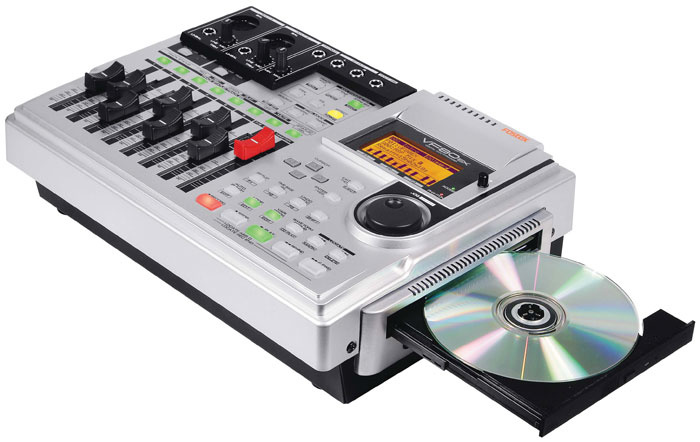
something new. The Fostex VF80EX (retailing at £298.45 when we went to
press, but now on sale in some shops for as little as £229) gives you
eight tracks of audio recording without data compression, S/PDIF digital
input and output, and an onboard CD burner. It would probably be quite a
good choice in your circumstances. The Tascam DP01FX might also be an
option (at a retail price of £345, but often discounted to as low as
£299), although this has no CD drive built in, so you'll have to back it
up to a computer over USB. It also has no digital input, so you're
stuck with the internal preamp and A-D electronics for recording. If you
went for the Fostex, you could, at a later date, connect a decent
mic/instrument preamp with built-in A-D conversion and hence bypass the
internal preamp electronics of the multitracker.
Digital recorders like the Fostex VF80EX and Tascam DP01FX offer affordable eight-track recording.
There are lots of other models of eight-tracker available in this
price range, but I wouldn't really recommend them over the ones I've
already mentioned for any serious recording. For a start, most other
multitrackers in this price band use data compression for recording,
which I wouldn't recommend if there's any chance that you might want to
use anything you record on your multitracker for a proper commercial
record production later on. Some models record to solid-state memory
(such as Smart Media or Compact Flash cards), and usually don't include a
particularly large card at the outset, so you'll have to budget for
additional cards as well. Many cheaper multitrackers also don't offer
phantom-powered mic inputs, which means you won't be able to use the
majority of decent condenser mics unless you already own an external
preamp or mixer.
If you're willing to look into the second-hand market, there's a lot
more choice, but I'd steer clear of Minidisc multitrackers, again for
data-compression reasons — technology has moved on quite a way from
these now. You might even be able to pick up a 16-track machine within
your price range in the SOS Readers Ads. In particular, keep
your eyes peeled for a Korg D16 — it's small and has great effects, a
built-in CD-RW drive and a touchscreen, but no phantom power — or a
Fostex VF160, which has phantom power, a built-in CD-RW and individual
track faders, but slightly underwhelming effects and mixing
capabilities. Both machines will also record eight tracks at once and
include S/PDIF digital input and output.
I
have an odd, but I'm sure not uncommon, problem that I hope your
experienced staff can help with. This time of year the outside world is
an especially ghastly, germ-ridden place. During a rare occasion out of
the studio last week, I managed to catch myself a cold. This would not
normally be a problem, only I had some very important work to complete
and mix by the end of the week. So, replacing the biscuit tin with a box
of tissues and a mug of Lemsip, I soldiered on. However, all my
studious investment in fine hardware couldn't make up for the fact that
with blocked sinuses I felt like I was mixing with a motorcycle helmet
on! So, what I need to know is, are there any recommended products or
remedies (apart from hiring another mix engineer!) to use in this
situation? I have tried sinus sprays but they only work for an hour or
so and I'm slightly worried that over-use will affect my hearing in the
long term. My doctor doesn't really understand the issues either, which
doesn't help. We're only as good as our ears, right? Your help on this
issue would be more useful to me right now than any advice on speaker
placement, room treatment or the latest and greatest convolution reverb —
I can't hear it anyhow!
Simon West
Technical Editor Hugh Robjohns replies: This is not
an unusual problem and I completely sympathise. I tend to suffer from
this problem quite badly myself. All I can suggest is to find a good
decongestant that works for you. I find Olbas Oil safe and useful — pour
a few drops into a bowl of hot water and breathe the vapours for a
while. However, the congestion will inevitably come back.
There are lots of pharmaceutical decongestants available, but many
are combined with other drugs (paracetemol, for example) which limits
how often they can be taken, and some have side-effects that may not
agree with you. Try talking to your local chemist for specific product
advice — I generally find that approach more helpful than talking to the
doctor in situations like this.
But I'm afraid the bottom line is that your ears will not work properly until the cold has passed and the sinuses have cleared.
The PPG Wave wavetable synthesizer. This one belongs to synth programmer, engineer and producer Nigel Bates.
I keep reading about different types of synthesis like 'wavetable',
'S&S' and 'vector' but I don't know what they are. I've looked
around the net for information but either the descriptions are very
simplistic or they're too technical. Could someone at SOS please explain the origins of these techniques?
Michael Cullen
SOS contributor Steve Howell replies: 'Wavetable
synthesis' is actually quite easy to understand. In the early days of
synthesis, (analogue) oscillators provided a limited range of waveforms,
such as sine, triangle, sawtooth and square/pulse, normally selected
from a rotary switch. This gave the user a surprisingly wide range of
basic sounds to play with, especially when different waveforms were
combined in various ways.
However, in the late '70s, Wolfgang Palm [of PPG] used 'wavetable'
digital oscillators in his innovative PPG Wave synths. Instead of having
just three or four waveforms, a wavetable oscillator can have many more
— say, 64 — because they are digitally created and stored in a 'look-up
table' that is accessed by a front-panel control. As you move the
control, so you hear the different waveforms as they are read out of the
table — the control is effectively a 64-way switch. If nothing else,
this gives a wide palette of waveforms to use as the basis of your
sounds. However, the waveform-selection control is not a physical switch
as such, but a continuously variable control implemented in software.
The advantage this has (apart from the 60 extra waveforms!) is that it
is also possible to use LFOs or envelopes or MIDI controllers to step
through these waveforms.
Now, if the waveforms are sensibly arranged, we can begin to create
harmonic movement in the sound. For example, if Wave 1 is a sine wave
and Wave 64 is a bright square wave with Waves 2 to 63 gradually getting
brighter as extra harmonics are added in each step of the wavetable, as
you move through the wavetable, you approach something not unlike a
traditional filter sweep. However, one disadvantage to this (but
something that characterised the PPG) is that the sweep will not be
smooth — the waveforms will step in audible increments.
Each oscillator in the PPG, however, didn't just have one wavetable —
there were 32 wavetables, each with 64 waveforms! Many were simple
harmonic progressions as described above; others were rudimentary
attempts at multisampling, whilst others attempted to emulate oscillator
sync sweeps and PWM (pulse-width modulation) effects. Because the
wavetable sweeping was so audibly stepped, the latter two weren't
entirely convincing emulations, though they had a character all their
own nonetheless.
Where things begin to get interesting, however, is when the waveforms
in the wavetable are disparate and harmonically unrelated, as the tonal
changes become random and unpredictable. For many, this feature of
wavetable synthesis was unusable, but some creative individuals like Tom
Dolby exploited it to create unique and distinctive sounds, as can be
heard on his 1982 album The Golden Age Of Wireless.
The PPG had something of a trump up its sleeve, however — totally
analogue filters! Using these, it was possible to smooth out the
wavetable sweeps. Another endearing quality of the PPG was its
low-resolution digital circuitry, which exhibited aliasing at extreme
frequencies that added a certain 'gritty' quality to the sound. Later
manifestations of the PPG (in Waldorf products) were of a higher quality
and offered smooth wavetable sweeping. But while they sounded better,
they lacked that (arguably) essential 'lo-fi' character.
Other synths have employed wavetable synthesis in one guise or
another since then and there are several software synths available today
which incorporate wavetable synthesis capabilities. The massively influential Korg M1 really put S&S synthesis on the map.
'S&S' is an abbreviation for 'samples and synthesis' and
refers to the new breed of synth that appeared with the introduction of
the seminal Roland D50 in 1987. Whereas synths prior to this used
analogue or digital oscillators to create sound, samplers were now in
the ascendent, with the introduction of affordable sampling products
such as the Ensoniq Mirage, the Emu Emax and the Akai S900. These
allowed almost any sound to be sampled and mangled but they had one
inconvenience — the samples took time to load and were inconveniently
stored on floppy disks. Roland could see that by using short samples as
the basic sound sources, and storing them in ROM for instant recall,
they could make the same type of sound as a sampler but with no tedious
load times. However, they also retained many of their previous
synthesizers' functions such as multi-mode filters, envelopes, LFOs and
so on. To all intents and purposes, the D50 'felt' like a synth but
sounded like a sampler. Furthermore, to smooth out any inadequacies in
the very short samples such as clicky and/or obvious loops, the D50 also
had chorus and reverb which 'smudged' these artifacts quite
effectively.
And so a legend — and a new synthesis method — was
born! Roland called it 'LA (linear arithmetic) synthesis'. In truth, it
was a simple layering method where up to four samples could be stacked
to create more complex sounds. Because of memory constraints (ROM/RAM
was very expensive at the time), Roland had to use very short samples,
and there were two categories of sample on the D50 — short, unlooped
samples (such as flute 'chiff' or guitar 'pluck') and short sustaining
loops. By combining and layering, for example, a flute 'chiff' with a
sustained flute loop sample, you could (in theory) create a realistic
flute sound. In practice, it didn't quite work out like that, but this
layering technique also gave the instrument a new palette of sounds to
work with and it was possible to layer, say, the attack of a piano with
the sustain of a violin. With the wealth of synthesis functions
available to process the samples, this allowed the user to create
interesting hybrid sounds.
Korg took this concept to a new level a
year or so later when they released their M1, another legend in modern
music technology. Although similar concepts were involved, the M1 used
longer, more complete samples which, in conjunction with typical synth
facilities, blurred the distinction between synth and sampler and
arguably heralded the beginning of the slow, gradual demise of the
hardware sampler! However, as well as advancing S&S, they also added
a very functional multitrack sequencer and good quality
multi-effects so that (maybe for the first time) it was possible to
create complete works on a single, relatively affordable keyboard. And
so the 'S&S workstation' was born. I think it's fair to say that
most modern synths owe something to the Korg M1 in one or another aspect
of their design. The ill-fated Sequential Circuits Prophet VS introduced vector synthesis to the world.These
days, many synths and keyboards routinely use these same basic
principles, but memory is now far more affordable and so it is possible
to have many more (and considerably more detailed) multisamples in the
onboard ROM. Whereas early S&S synths boasted around 4MB of onboard
ROM, figures of 60MB or more are bandied about today. That said, many of
the same techniques used for optimising samples and squeezing as many
into ROM as possible are still used today.
'Vector synthesis' is a
slightly different (but related) technique. First pioneered by Dave
Smith in his Prophet VS, vector synthesis typically uses four
oscillators which the user can 'morph' smoothly between, using real-time
controllers such as a joystick or automated controllers such as LFOs
and/or envelope generators. As the joystick is moved, so the balance of
the four oscillators changes and, depending on the nature of the source
waveforms, many interesting, evolving sounds can be created. But the
Prophet VS was ill-fated — Sequential Circuits were in financial trouble
and the company soon went to the wall. However, the concept lived on in
the Korg Wavestation, which was a joint venture between a
post-Sequential Smith and Korg. The Wavestation had a significant
advantage over the VS in that it used multisampled waveforms, allowing
more complex building blocks to be used — in many ways, it was a hybrid
S&S and vector synth. As well as extensive synth facilities
(filters, multi-stage envelopes and so on), it also had comprehensive
multi-effects and other facilities (not least of which was 'Wave
Sequencing') that made the Wavestation a programmer's dream, and a
casual user's nightmare! Indeed, they are still a staple component in
many players' keyboard rigs today. The Wavestation was discontinued many
years ago (though it's been resurrected in Korg's Legacy Collection software), but vector synthesis lives on in Dave Smith's Evolver range of keyboards.
If you're looking for further information on synthesis out there on the web, I can suggest two sections of the Sound On Sound
web site worth investigating. Paul Wiffen's 12-part Synth School
series, which appeared in the magazine between June 1997 and October
1998, is a good introduction to the basics of synthesis in its various
forms. If you enter "synth school" into the search engine at www.soundonsound.com,
you'll find it. Judging by your comments, you may find some of Gordon
Reid's long-running Synth Secrets series too technical, but it's
nevertheless worth a mention as it covered so much ground in its
five-year tenure. To make this vast amount of material a little easier
to navigate, we have created a special page with links to all of the
Synth Secrets articles: www.soundonsound.com/sos/allsynthsecrets.htm.
The Zoom MRS1608's dedicated drum pads set it apart from other similarly priced multitrackers.
I read Tom Flint's piece on the Zoom MRS1608 multitracker and think
it may be the right machine for me. I still use a Roland TR707 drum
machine which allows you to step write and tap write. The sounds, of
course, are ancient. I write simple country songs, mostly backed by
drums and guitars. I think the Zoom's drum machine would be great for
what I do. I would think the guitar effects would also be pretty good on
this machine. I currently own the Tascam 2488. I think my recordings
sound really good on this machine, but I don't like the guitar effects
much and find them a little difficult to use. I don't even use the drum
machine and I don't use MIDI or edit much at all. Based on what I have
told you, do you think I would be pleased if I unloaded the Tascam and
bought the Zoom? I would appreciate your opinion on this subject and
thank you in advance.
Robert Tambuscio
SOS contributor Tom Flint replies: Before
they entered the multitracker market, Zoom were busy gaining a name for
themselves producing drum machines and guitar effects (amongst other
things), so you can expect a reasonable level of quality and competence
in both these areas. If I remember correctly, the MRS1608's internal
drums sounds are good and varied — if country music is your thing then
the chances are that the sounds in the MRS will serve you better than
the TR707! The MRS has 50 drum kits which should certainly include a few
that are suitable, and it is possible to take the best sounds from
various kits and create a custom kit yourself. If you're not satisfied
with the onboard sounds, the Pad Sampler facility allows AIFF and WAV
samples to be loaded from CD and used as alternative drum sounds.
Alternatively, you could use the Phrase Loop sampler to put together
drum and percussion loops taken directly from sample libraries, or
choose from among the MRS's 475 preset drum and bass patterns.
The sequencer itself offers both real-time and step-based recording,
so it should allow you to program drums in a similar way to the TR707,
although I believe the Zoom's grid has a finer resolution than the 707
and there are more time-signature options. It's also worth noting that
some of the Zoom's programming facilities will be familiar to TR users.
For example, just as the 707 has a set of faders for setting sound
levels for each kit component, the MRS allows the channel faders to be
used for adjusting its own drum samples. The Zoom multitracker also
benefits from having 12 touch-sensitive pads for triggering drums.
Tascam have a long history of producing multitrack recorders, but
they're not known as makers of effects or drum machines so it's not
surprising to hear that the 2488 hasn't quite lived up to your
expectations in these areas. It does have an internal GM sound module
with many useful drum and instrument sounds, and, like the MRS, it can
Import and play Standard MIDI files, but it doesn't have anything
approaching a pad bank, and there are no sampling facilities. So as far
as the drum machines are concerned, the MRS is much better equipped.
That said, a decent drum section shouldn't be your only
consideration. Before you offload the 2488, think carefully about
whether there are any recording, editing or mixing facilities that you
regularly use, and check they are also available on the Zoom. The Zoom
has a rather more basic display which may hinder its usability a little.
That has to be something to consider, given that you say you find some
of the 2488's features difficult to use. Without doing some objective
side-by-side testing it's impossible to say whether the Zoom sounds as
good as the Tascam or not, but I can say that I didn't think the Zoom
was particularly weak in that department, and I suspect there's little
to choose between them.
Nevertheless, I'd advise anyone using a budget multitracker to use a
good-quality external preamp for any important lead work if at all
possible, simply because the onboard preamps are not going to be of the
highest quality. What's more, if your preamp has a decent A-D converter
with an S/PDIF output built in, it would be a good idea to bypass the
multitracker's converters by using its S/PDIF input, and clocking the
multitracker to the preamp's digital clock.
Normally I'd probably suggest upgrading to a better machine when
trading in your old multitracker for a new one, but there aren't really
any high-end products which go in for drum machines and sequencers in
quite the same way as the MRS1608, so I'm not sure you have much choice
if you really want these kinds of features. The other option would be to
hold onto the Tascam 2488 and buy a more modern drum machine — Alesis,
Boss and Zoom all make self-contained drum machines which cost less than
£300 — and slave it to the 2488 via MIDI.