Tuesday, February 3, 2015

Q. Does it make sense for me to mix with a mono 'grot box'?
Sound Advice : Mixing
I realise that there are advantages to monitoring on a single 'middly'-sounding small speaker (such as an Avantone MixCube) from time to time while mixing, to get an idea of what the music might sound like on typical cheap consumer playback systems. However, I mix mainly deep house and lounge, which is quite rich in high and low frequencies, and these are easily conveyed by the full-range playback systems in trendy restaurants, cafes and clubs, but not by these small monitors. Does using one while mixing, therefore, actually make any sense for me? Also, if I did decide to get a single MixCube, I guess the best place to put it would simply be in the middle of the desk, but the problem is that that's where my computer screen is! Should I buy a higher speaker stand to go above my screen and angle the Avantone down towards me?
Nicolas Issid via email

SOS contributor Mike Senior replies: If your music were only ever played on larger full-range systems like those you mention, the usefulness of limited-bandwidth referencing would indeed be reduced. However, I'd personally think twice about targeting the sound too narrowly for one type of playback system, and would be inclined to prepare my music for lower-resolution playback in case it, for any reason, gets transmitted for wider consumption — on the Internet, say, or as part of a TV programme, radio advert or computer game.Rather than buying a mixer with lots of outputs and manually routing sound effects to different speakers for a theatre production, why not use a dedicated computer-based 'playout' system, in conjunction with a multi-output soundcard or audio interface? Some suitable software is even available free.Rather than buying a mixer with lots of outputs and manually routing sound effects to different speakers for a theatre production, why not use a dedicated computer-based 'playout' system, in conjunction with a multi-output soundcard or audio interface? Some suitable software is even available free.Even if you mix music primarily aimed at full-range venue playback systems, there's still something to be gained at mixdown from checking your mix on a single small speaker.Even if you mix music primarily aimed at full-range venue playback systems, there's still something to be gained at mixdown from checking your mix on a single small speaker.

That apart, though, I think you're slightly underestimating the value of something like the Avantones, because they're not just about the 'middly' frequency response. Their small-scale, single-driver, portless design makes them much more revealing as far as simple mix balance issues are concerned (ie. for deciding what level each instrument should be at) than almost any even marginally affordable full-range nearfield/midfield monitoring system. This is even more the case if you use only one such speaker, rather than a stereo pair, as you also avoid inter-speaker phasing issues. Overall, I think you'd still benefit a great deal from this kind of speaker even if you mix primarily for larger speaker systems.
As far as speaker placement is concerned, in my opinion it doesn't really matter much where you put it, as long as it's pointing roughly in your direction and you're not getting acoustic reflection problems from a nearby room boundary or other hard surface. The only disadvantage of mounting a single speaker off centre is that it may temporarily skew your stereo perception to one side after you've been listening for a while. Not that this is actually a significant mixing problem in practice, though, because it's very easy to work around.
I realise that there are advantages to monitoring on a single 'middly'-sounding small speaker (such as an Avantone MixCube) from time to time while mixing, to get an idea of what the music might sound like on typical cheap consumer playback systems. However, I mix mainly deep house and lounge, which is quite rich in high and low frequencies, and these are easily conveyed by the full-range playback systems in trendy restaurants, cafes and clubs, but not by these small monitors. Does using one while mixing, therefore, actually make any sense for me? Also, if I did decide to get a single MixCube, I guess the best place to put it would simply be in the middle of the desk, but the problem is that that's where my computer screen is! Should I buy a higher speaker stand to go above my screen and angle the Avantone down towards me?
Nicolas Issid via email

SOS contributor Mike Senior replies: If your music were only ever played on larger full-range systems like those you mention, the usefulness of limited-bandwidth referencing would indeed be reduced. However, I'd personally think twice about targeting the sound too narrowly for one type of playback system, and would be inclined to prepare my music for lower-resolution playback in case it, for any reason, gets transmitted for wider consumption — on the Internet, say, or as part of a TV programme, radio advert or computer game.Rather than buying a mixer with lots of outputs and manually routing sound effects to different speakers for a theatre production, why not use a dedicated computer-based 'playout' system, in conjunction with a multi-output soundcard or audio interface? Some suitable software is even available free.Rather than buying a mixer with lots of outputs and manually routing sound effects to different speakers for a theatre production, why not use a dedicated computer-based 'playout' system, in conjunction with a multi-output soundcard or audio interface? Some suitable software is even available free.Even if you mix music primarily aimed at full-range venue playback systems, there's still something to be gained at mixdown from checking your mix on a single small speaker.Even if you mix music primarily aimed at full-range venue playback systems, there's still something to be gained at mixdown from checking your mix on a single small speaker.

That apart, though, I think you're slightly underestimating the value of something like the Avantones, because they're not just about the 'middly' frequency response. Their small-scale, single-driver, portless design makes them much more revealing as far as simple mix balance issues are concerned (ie. for deciding what level each instrument should be at) than almost any even marginally affordable full-range nearfield/midfield monitoring system. This is even more the case if you use only one such speaker, rather than a stereo pair, as you also avoid inter-speaker phasing issues. Overall, I think you'd still benefit a great deal from this kind of speaker even if you mix primarily for larger speaker systems.
As far as speaker placement is concerned, in my opinion it doesn't really matter much where you put it, as long as it's pointing roughly in your direction and you're not getting acoustic reflection problems from a nearby room boundary or other hard surface. The only disadvantage of mounting a single speaker off centre is that it may temporarily skew your stereo perception to one side after you've been listening for a while. Not that this is actually a significant mixing problem in practice, though, because it's very easy to work around.
Monday, February 2, 2015
Q. Is the quality of S/PDIF connections on soundcards variable?
Is there any difference between the quality of S/PDIF connections on low-end and high-end soundcards, or am I right in thinking that a low-end card with S/PDIF I/O (and the ability to clock from the A-D converter) should be adequate?
Via SOS web site

If a soundcard is well made, its S/PDIF interface should be quality independent, so the difference between low-end and high-end cards should be minimal in this respect.If a soundcard is well made, its S/PDIF interface should be quality independent, so the difference between low-end and high-end cards should be minimal in this respect.
SOS Technical Editor Hugh Robjohns replies: In theory, S/PDIF is quality independent, assuming that the physical interface is engineered reasonably in the first place. It is purely about transferring the data — there's no jitter to worry about — so, provided you have decent 75Ω cables of modest length, it should just work. I've had very few problems with S/PDIF interfaces, and the few issues I did find were actually caused by ground loops.
Personally, I prefer AES3 interfaces, because they will cope with longer cables and are always ground-free, transformer-coupled connections (often S/PDIF is as well, but not always). And XLRs are so much more reliable than RCA phono plugs!
Via SOS web site
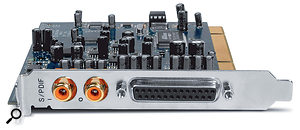
If a soundcard is well made, its S/PDIF interface should be quality independent, so the difference between low-end and high-end cards should be minimal in this respect.If a soundcard is well made, its S/PDIF interface should be quality independent, so the difference between low-end and high-end cards should be minimal in this respect.
SOS Technical Editor Hugh Robjohns replies: In theory, S/PDIF is quality independent, assuming that the physical interface is engineered reasonably in the first place. It is purely about transferring the data — there's no jitter to worry about — so, provided you have decent 75Ω cables of modest length, it should just work. I've had very few problems with S/PDIF interfaces, and the few issues I did find were actually caused by ground loops.
Personally, I prefer AES3 interfaces, because they will cope with longer cables and are always ground-free, transformer-coupled connections (often S/PDIF is as well, but not always). And XLRs are so much more reliable than RCA phono plugs!
Q. Can I use two completely different mics in an M/S array?
Sound Advice : Miking
I have a vintage Neumann U87 mic, a GAP Pre73 preamp and also a Zoom H4N recorder (massive contrast, I know). If I want to, can I use these in a Mid/Side setup with the Neumann as the Mid mic and the H4N for the Side? Or should I use the U87 in a figure-of-eight polar pattern for the Side and another mic — my Shure SM7B or Rode M3 — as the Mid? How, then, would I combine the two into a Mid/Side audio file?

Via SOS web site
SOS Technical Editor Hugh Robjohns replies: Using such radically different mics to form an M/S array is never going to give great results; the stereo imaging will tend to be rather variable and frequency dependent because of their mismatched frequency responses.
However, for experimental purposes I'd suggest using the U87 in figure-of-eight mode for the Side mic and either the SM7 or M3 as the Mid mic. I suspect you'll still find quite a lot of image instability, but it should work well enough to give you a feel for the versatility and practicalities of the M/S mic technique.
All you need to do to create a Mid/Side file is allocate the Mid mic to channel one and the Side mic to channel two, and record as a normal stereo file.
 Regarding rigging the mics, the normal convention is that the in-phase side (front) of the figure-of-eight mic — the U87, say — faces to the left of the sound stage (as viewed from behind the mic array, looking towards the sound sources).Although our reader may never achieve great results using vastly different mics in an M/S setup, it may still be worth him experimenting with his U87 in figure-of-eight mode as a Side mic and his Rode M3 as a Mid mic.Although our reader may never achieve great results using vastly different mics in an M/S setup, it may still be worth him experimenting with his U87 in figure-of-eight mode as a Side mic and his Rode M3 as a Mid mic.Q. Can I use two completely different mics in an M/S array?
You should also set the preamp channel gains to provide a similar sensitivity for both mics, to optimise the signal-to-noise ratio and make the decoder work properly. The easiest way to do that is to decide how wide you want the sound stage to be — decide where the notional edges of the stereo pickup area are — and then get an assistant to stand at the nominal left-hand edge and make a fairly constant noise, such as humming. Assuming the Mid mic output is already providing an appropriate level (if not, adjust that first), set the gain of the Side mic's preamp to give an approximately equal output level to that provided by the Mid mic's preamp.
Question of the month
I have a vintage Neumann U87 mic, a GAP Pre73 preamp and also a Zoom H4N recorder (massive contrast, I know). If I want to, can I use these in a Mid/Side setup with the Neumann as the Mid mic and the H4N for the Side? Or should I use the U87 in a figure-of-eight polar pattern for the Side and another mic — my Shure SM7B or Rode M3 — as the Mid? How, then, would I combine the two into a Mid/Side audio file?

Via SOS web site
SOS Technical Editor Hugh Robjohns replies: Using such radically different mics to form an M/S array is never going to give great results; the stereo imaging will tend to be rather variable and frequency dependent because of their mismatched frequency responses.
However, for experimental purposes I'd suggest using the U87 in figure-of-eight mode for the Side mic and either the SM7 or M3 as the Mid mic. I suspect you'll still find quite a lot of image instability, but it should work well enough to give you a feel for the versatility and practicalities of the M/S mic technique.
All you need to do to create a Mid/Side file is allocate the Mid mic to channel one and the Side mic to channel two, and record as a normal stereo file.
 Regarding rigging the mics, the normal convention is that the in-phase side (front) of the figure-of-eight mic — the U87, say — faces to the left of the sound stage (as viewed from behind the mic array, looking towards the sound sources).Although our reader may never achieve great results using vastly different mics in an M/S setup, it may still be worth him experimenting with his U87 in figure-of-eight mode as a Side mic and his Rode M3 as a Mid mic.Although our reader may never achieve great results using vastly different mics in an M/S setup, it may still be worth him experimenting with his U87 in figure-of-eight mode as a Side mic and his Rode M3 as a Mid mic.Q. Can I use two completely different mics in an M/S array?
You should also set the preamp channel gains to provide a similar sensitivity for both mics, to optimise the signal-to-noise ratio and make the decoder work properly. The easiest way to do that is to decide how wide you want the sound stage to be — decide where the notional edges of the stereo pickup area are — and then get an assistant to stand at the nominal left-hand edge and make a fairly constant noise, such as humming. Assuming the Mid mic output is already providing an appropriate level (if not, adjust that first), set the gain of the Side mic's preamp to give an approximately equal output level to that provided by the Mid mic's preamp.
Question of the month
Subscribe to:
Posts (Atom)