Tuesday, January 20, 2015

Finding The Right PA System For You
Primer
Sound Advice : MikingThinking of taking your act to the stage? Then you'll need a suitable way of amplifying it, and that all depends on what and where you're playing...
Paul White
Finding The Right PA System For You
Most articles on PA systems start out by explaining how the various types of speaker cabinet work, but in this one I'm going to try to approach the subject from a different angle: looking at common types of act and venue, and then suggesting practical PA solutions for them.
These suggestions are based on the assumption that many of today's musicians travel by car rather than by van, and that they'd therefore like something as light and portable as possible that will still be able to do the job properly. Speaker systems have become more compact and more efficient over recent years, with the introduction of technologies such as switching-mode power supplies and Class-D amplifiers. This means that active speakers can be made to weigh very little more than their passive equivalents, while still being more convenient to set up, as there's less need for cabling. There's another advantage to active systems, in that suitable speaker protection can be, and usually is, built in.
A further advantage is that if each speaker has its own amp, you can muddle along on one speaker if the other fails. However, some small systems are based around two satellite speakers and a sub, where all the power amps are in the sub — so if the sub electronics fail, you lose your entire PA. This happened to me once while playing a small pub, but happily we were able to utilise the powered monitors as a substitute PA to get through the evening — it pays to always have a backup plan!
Going Solo?
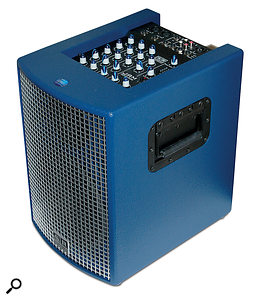
For smaller gigs, acoustic instrument amplifiers will often serve well as compact PA systems, as many of them incorporate simple mixer functionality and can accommodate both mic and instrument inputs.For smaller gigs, acoustic instrument amplifiers will often serve well as compact PA systems, as many of them incorporate simple mixer functionality and can accommodate both mic and instrument inputs.
Where the performer relies entirely on an instrument such as guitar or electric piano for accompaniment, rather than on backing tracks, a combo amp designed for acoustic guitar is often perfectly adequate for smaller venues. Unlike electric guitar amps, which are designed to impart their own sound, acoustic amps are essentially miniature PA systems, intended to simply amplify the signal going into them. They almost invariably offer an XLR mic input in addition to the instrument input, and so are ideal for singer/songwriter types. The speaker systems in such amps either use small full-range drivers or a driver teamed with a tweeter. They can all handle the vocal range perfectly adequately, and most also include some basic effects, such as reverb, making them good all-in-one solutions.
As long as they're not set up too high from the ground, combos can be used behind the performer at a reasonable level before feedback becomes a problem. The majority also include a pole-mount socket, facilitating mounting on a speaker stand.
I'd recommend a model of at least 70 Watts for small gigs, but do bear in mind that the amplifier power rating alone doesn't give an accurate indication of how loud the amplifier can go. The efficiency of the loudspeakers also plays a major part, so when you read the spec sheet, the SPL (Sound Pressure Level) is the most significant figure. To give you an idea of typical SPL figures, small combos are almost all capable of producing around 105dB (measured at one metre), but from a good full-size '12-inch plus horn' cabinet you could expect around 130dB, and sometimes even more.
AER are seen by many as the benchmark for compact acoustic guitar amplifiers, but there are models from many other manufacturers at a range of price points and power ratings. I've had personal experience with AER, Schertler, Fishman and Vox models, and have also heard good reports of Tanglewood acoustic amps, so all these makes are worth checking out.
Adding Up
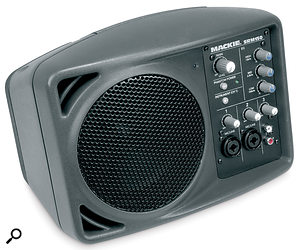
Compact, active PA cabinets can be put to good use as extension speakers to complement acoustic amps or small PA systems.Compact, active PA cabinets can be put to good use as extension speakers to complement acoustic amps or small PA systems.
At larger venues, or those where a greater spread of sound is beneficial (those awkward L-shaped bars, for example), you can add an extension active speaker cabinet, as acoustic guitar amps usually include an XLR DI or link output, which can also be used to feed a large PA system at big gigs. A fairly small powered two-way cabinet (8- to 12-inch woofer plus horn) rated at anything from 100 Watts upwards will do the trick. I've used a Mackie SRM350, which has a 10-inch driver, on many occasions and found it to work well, and for smaller bar gigs I've even used a Mackie SRM150 powered mini-monitor as an extension speaker, with good results.
The Next Step
The human voice and the acoustic guitar don't usually produce low enough frequencies to require a great deal of bass extension, which is one reason why compact systems can produce great-sounding results. However, once you bring backing tracks, electronic keyboards or a full band with bass and drums into the equation, adequate bass handling becomes essential.
The solution you choose will depend on the range of venue sizes you tend to play. If you only play pubs, one of the smaller 'sub plus two satellites' systems may be the most appropriate, as these can still be compact enough to fit into a car, yet powerful enough to produce a satisfying musical experience. Good examples of this type of system include the smaller HK Lucas packages and LD Systems Dave setups. Because the sub takes over all the bass-handling duties, the satellite speakers can be made very compact — right down to shoe-box size — and even the sub itself might house only a single 10- or 12-inch speaker in the smaller systems. Most of these systems can produce a good stereo image even though there's only one sub, as very low frequencies are almost omnidirectional and it is difficult for the human hearing system to pinpoint the source.

For smaller venues, and with simpler 'singer/songwriter' type acts, a basic two-speaker system without subwoofers may be all that's needed.For smaller venues, and with simpler 'singer/songwriter' type acts, a basic two-speaker system without subwoofers may be all that's needed.Because it's difficult to combine small size with high efficiency, and because it requires more power to achieve the same SPL at low frequencies as it does at high frequencies, I'd consider a system power of around 300 Watts to be a minimum for performers using backing tracks, or a mainly acoustic band playing the pub circuit. In such situations, acoustic feedback often sets the operating level threshold well below the PA system's actual handling capacity. Just be aware that if there are bass instruments that need amplifying, you'll need a more powerful sub. See also the 'Line Arrays' box, as the smaller line-array systems lend themselves to anything from solo performers, duos and acoustic acts to rock bands playing pubs and smaller clubs — and most can be expanded for use in larger venues. I've used both the smaller Fohhn Linea 100 and HK Elements system with my own band, and we've always had a great vocal sound. Even using just a single 12-inch sub with the Linea, we've been able to put the guitars and keyboards through the system, but if you need more than a hint of drums and bass in the PA, moving to a 15-inch sub (or two) should be considered the minimum option.
If you're not ready to embrace the line-array approach (and a decent line array can still be quite expensive to a band on a budget), there's plenty of mileage left in conventional 12-inch-plus-horn active speakers. These can be used on their own where the primary purpose is to carry vocals, acoustic guitars and so on, or in conjunction with a sub where bass instruments and kick drums need a little help. In theory, many of these so-called full-range boxes boast a frequency response of down to 50Hz or so, but the bass sound from such a box is seldom good and bass frequencies eat up so much headroom that the overall system level will be severely compromised. In other words, if you need to amplify bass, add appropriate subs, don't thrash your main speakers. Both active and passive subs typically include crossovers that reduce the amount of low end reaching the main speakers, allowing the latter to give of their best in the vocal range and above.
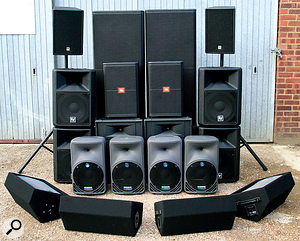
Sub-and-top PA systems can be made extremely portable, and they have the advantage that you can take only the elements of the system that you need for each gig.Sub-and-top PA systems can be made extremely portable, and they have the advantage that you can take only the elements of the system that you need for each gig.While plastic speaker boxes, such as the popular Mackie SRM and JBL Eon models, are resilient and adequately loud, many of the cheaper (and some of the less cheap) plastic boxes can sound a little resonant and blurred in the lower mid-range when heard alongside a good plywood or MDF cabinet. Although wooden cabinets are often a little larger, their flat, straight sides can also make them easier to stack in a car. Whether you go for wood or plastic, however, one factor that is common to all of them is that the bigger the main driver, the more difficult it is for the designers to get the frequency ranges of the woofer and HF horn to meet properly in the middle. Ten-inch woofers have limited power handling but tend to team well with a horn, and the same is true of a well-designed 12-inch system. But once you get up to 15-inch, only the better designers seem to pull the trick off successfully, and the crossover frequency tends to fall right in the middle of the vocal range, so if it isn't done right you won't get a natural vocal sound.
 A couple of decent 12-inch main speakers ('tops') teamed with one or two 15-inch or 18-inch subs will tackle just about any situation, from the local pub to a beer festival, and you have some limited scalability in that you can take just one sub for smaller gigs and both for larger ones, or in very small pubs you may not want to put the bass or kick drum through the PA at all, so you can leave the subs at home.
If you play a variety of venue sizes, it makes sense to buy a scalable system, where you can take only the components that are needed to do the job, rather than hauling the entire system around with you everywhere. For example, two smaller subwoofers may be more practical than one large one in this respect, as you can leave one or both behind when needs dictate. You can also add more top cabinets when you graduate to larger venues, although in my experience there are few venues requiring larger systems that don't have their own in-house PAs.
I've handled music days in the local park bandstand with everything from folk to punk using just a pair of Mackie SRM450s and a Mackie 15-inch sub, although in recent years I've been using HK Premium Pro 12-inch tops and a single 15-inch Fohhn sub. The Premium Pro cabinets fall at the budget end of the HK range, but they still produce very credible results if you don't need huge amounts of level. If you go further upmarket, to their Actor range, or use a premium brand such as Fohhn, you can cover a rugby pitch using as little as two 12-inch tops and two 18-inch subs (as I often do at Malvern's annual West Fest music festival).
False Economies
Where more volume is needed, especially if you need to put bass or drums through the PA, a subwoofer is pretty much essential.Where more volume is needed, especially if you need to put bass or drums through the PA, a subwoofer is pretty much essential.

There are systems to cover every venue size and every budget but, as in most areas, you get what you pay for. In the world of PA, this tends to mean that spending more money not only gets you a better sound, it also gives you something more compact and portable. A high-end system might seem expensive, but it probably takes up less than half the space of a comparable system built using cheaper components, and most likely still sounds noticeably better. Spending a little more on the PA itself might mean that you can do away with the need for a van and take all your gear in cars, so factor these savings into the price.
Seemingly compact systems — such as the little line arrays I've mentioned — can, if well designed, fill surprisingly large venues, often carrying to the back of the room better than conventional box systems. They can be made so compact because all the heavy work is offloaded to the sub, leaving the relatively small mid-range/high-frequency units to carry the less burdensome part of the audio spectrum. Modern drivers are also more efficient than those of last generation, while Class-D amps pack an enormous amount of power into a much smaller and lighter package than is possible with a conventional analogue amplifier, so good doesn't have to mean heavy. A quality system will last a great many years, so it pays to choose carefully and to buy the very best you can afford.
Line Arrays For Smaller Venues
Though they may seem expensive, modern compact line-array systems are very easy to transport and can offer extremely good coverage and sound quality.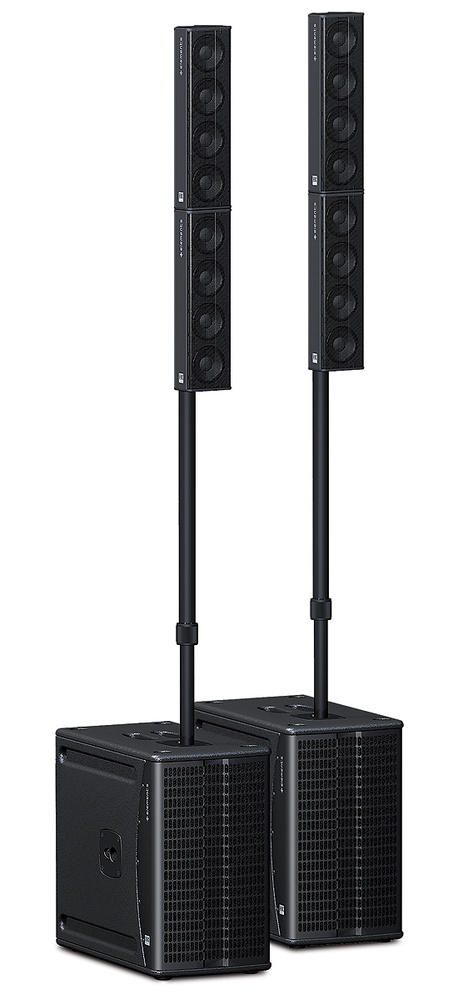 Most of us have seen huge line-array speaker
systems hanging above the stage at arena-sized gigs, often laid out in
a vertical curve to provide even coverage from the front of the
auditorium to the back. But in the last few years, the design ideas
behind these large systems have been scaled down, and there's a lot to
be said for using compact line arrays at smaller gigs, not least because
of their small physical size when used in conjunction with a separate
sub.
Most of us have seen huge line-array speaker
systems hanging above the stage at arena-sized gigs, often laid out in
a vertical curve to provide even coverage from the front of the
auditorium to the back. But in the last few years, the design ideas
behind these large systems have been scaled down, and there's a lot to
be said for using compact line arrays at smaller gigs, not least because
of their small physical size when used in conjunction with a separate
sub.A line array is, at heart, a vertical stack of drive units, not unlike the modern equivalent of the column speakers used back in the '60s and '70s. The key benefit of a line array is that stacking drivers near-vertically changes the dispersion pattern of the resulting sound. Even a relatively modest line array measuring a metre or so long can exhibit a very tightly controlled vertical dispersion (as little as one-third of the horizontal dispersion angle). In practical terms, this means more sound is thrown onto the audience and less onto the ceiling or floor. Their horizontal dispersion tends to remain fairly wide too, so the overall coverage might be imagined as being fan-shaped.
A lesser known benefit of such a tightly-controlled dispersion pattern is that the sound level remains more consistent as you move further back in the venue than it does from a standard speaker box containing a woofer and a horn. Your audience will thank you for this, as you can work with a manageable SPL at the front of the room where the audience is close to the speakers, yet still have enough sound reaching the rear.
Good examples of compact line arrays include HK's Elements (10-inch subs plus columns of small-diameter mid/high drivers), the Fohhn Linea system (which uses a single separate tweeter, so bends the true line-array rules slightly), and LD's recent VA4 and VA8 setups. Fishman also make one without a sub for acoustic guitar players and singers.
The small size of such systems can lead to the incorrect impression that compact line arrays are too small for use with a conventional band, but my own experiences have confirmed that not only can they hold their own against traditional 'box' systems, they can actually sound more natural over the vocal range and produce more even coverage in difficult venues. My own view is that for pub and club gigs, the compact line array is the future, although they have a limitation of which you need to be aware: while conventional boxes can be stacked in a number of ways to increase the power handling, a line array can only be made longer (taller) — you can't put them side-by-side and still have them behave correctly. You can add more subs, of course, but the practical limit of, for example, the original HK Elements system, is around 8kW, using a line of 16 small drivers per side and eight 10-inch subs. (Just announced at the time of writing is a newer version that can accommodate up to 24 drivers per side in a stack of three eight-driver modules, in combination with their newly designed and more powerful 2 x 10-inch subs.)
Despite its appearance, the Bose L1 you may have heard about isn't designed as a traditional line array, as the drivers are angled to produce a very wide horizontal dispersion. I've attended practical tests against conventional line arrays set up to produce the same SPL at a given distance, where the Bose system sounded extremely good with very even coverage when the listener was reasonably close, but in a very large room the sound did drop away quite quickly with distance.
The Sub Way
You'll find a range of passive and active subwoofers on the market, and some of the better ones are capable of generating at least 125dB SPL. However, this measurement is only part of the story. Many subs are ported and tuned to sound impressively deep and powerful, but in reality their resonant tuning creates a degree of note 'overhang', making bass sounds less distinct than they should be. In other words, a kick drum that should go 'thud' ends up going 'boom'!
When
you're auditioning subs indoors (such as in a shop or showrooom), it can
be difficult to separate problems arising from the speaker design from
those caused by the room, but at an outdoor event they could become very
noticeable. Sealed-box subs create the tightest sound, but you need
a fairly large box to allow a 15-inch or 18-inch driver to work
efficiently at low frequencies. You can get away with using a pair of
smaller subs with 10- or 12-inch drivers each, but the available SPL
from a pair of smaller drivers is often somewhat lower than from one big
one.
Q. Are expensive multicore cables really worth the money?
I've been looking at multicores, and wondering how much quality matters. People say that only the best cables should be used, and I know a cheaper one would probably break sooner, but is there a massive difference between a $100 and a $300 one? Am I likely to suffer more crosstalk and interference with a cheaper multicore?
High-quality multicore cables can be very expensive, but whether or not you should spend the money may simply come down to how you plan on using them. A less expensive one may actually last very well if you're not planning on moving it from venue to venue, night after night.High-quality multicore cables can be very expensive, but whether or not you should spend the money may simply come down to how you plan on using them. A less expensive one may actually last very well if you're not planning on moving it from venue to venue, night after night.

Via SOS web site
SOS Technical Editor Hugh Robjohns replies: A lot depends on how you plan to use the multicore. For example, if it's being gigged in different venues every night, and pulled and kicked about by roadies desperate to get a curry before the restaurant closes, a cheap one will probably lose channels almost daily and be completely dead within the month. On the other hand, if it's part of a permanent install in a private studio and used carefully only by you, a cheap one will probably last a lifetime.
The multicore cable itself isn't really the issue, although it is certainly true that better cables (by which I mean lighter, more flexible, with better screening, and designed to be easier to terminate) do cost more. However, most of the cost of a multicore system actually goes on the construction, and paying more generally means you get better quality connectors and a much better standard of internal wiring in the end boxes.
Systems with detachable end or breakout boxes are more expensive than those with permanently wired breakout boxes, because of the additional connectors and wiring involved. They are often easier to rig and de-rig, and can be more reliable in heavy-use situations, but the quality of the cable and box connectors is critical — and good ones are frighteningly expensive!
High-quality multicore cables can be very expensive, but whether or not you should spend the money may simply come down to how you plan on using them. A less expensive one may actually last very well if you're not planning on moving it from venue to venue, night after night.High-quality multicore cables can be very expensive, but whether or not you should spend the money may simply come down to how you plan on using them. A less expensive one may actually last very well if you're not planning on moving it from venue to venue, night after night.

Via SOS web site
SOS Technical Editor Hugh Robjohns replies: A lot depends on how you plan to use the multicore. For example, if it's being gigged in different venues every night, and pulled and kicked about by roadies desperate to get a curry before the restaurant closes, a cheap one will probably lose channels almost daily and be completely dead within the month. On the other hand, if it's part of a permanent install in a private studio and used carefully only by you, a cheap one will probably last a lifetime.
The multicore cable itself isn't really the issue, although it is certainly true that better cables (by which I mean lighter, more flexible, with better screening, and designed to be easier to terminate) do cost more. However, most of the cost of a multicore system actually goes on the construction, and paying more generally means you get better quality connectors and a much better standard of internal wiring in the end boxes.
Systems with detachable end or breakout boxes are more expensive than those with permanently wired breakout boxes, because of the additional connectors and wiring involved. They are often easier to rig and de-rig, and can be more reliable in heavy-use situations, but the quality of the cable and box connectors is critical — and good ones are frighteningly expensive!
Monday, January 19, 2015
Q. How and when should I normalise my mix?
I have a question about normalising. I mix from Cockos Reaper through an M-Audio ProFire 2626 interface into an Allen & Heath ZED12 FX mixer, and then back into Reaper. I often find that the end mix level is lower than expected, and I have to push the master fader on the desk up over zero. I do set the gain correctly for each hardware channel, using the PFL button, and I have the outputs of the 2626 up at maximum. My worry is that if I start pushing up the levels of the individual track faders on the mixer, I'll start introducing unwanted hiss from the hardware, so I tend to mix to a maximum of unity gain on the individual channels — but maybe I should start going beyond that? Also, if I do normalise my mix, should I do it before I apply my master-bus processing (a bit of compression and limiting), or should I apply the master-bus processing first and then normalise that processed file to take full advantage of the available digital headroom?
Simple gain plug-ins, such as GVST's freeware GGain, are tremendously handy when mixing in a DAW, partly because they give you more control over the level arriving at any analogue-modelled plug-ins in your collection — a factor that can be crucial to their tone.Simple gain plug-ins, such as GVST's freeware GGain, are tremendously handy when mixing in a DAW, partly because they give you more control over the level arriving at any analogue-modelled plug-ins in your collection — a factor that can be crucial to their tone.
Timo Carlier via email
 SOS contributor Mike Senior replies: The first main issue here is avoiding unwanted noise and distortion from your analogue components, and a good basic principle to bear in mind is to maximise your signal-to-noise ratio as early as possible for each piece of equipment, and then to leave any subsequent gain controls at their unity-gain position if possible. So in your situation, make sure the signals you're routing out of Reaper are making full use of the digital output headroom, so that you're sending the maximum level out of the ProFire 2626's sockets. (Check also that the faders in the ProFire's own mixer utility are set to unity gain, so that they don't undermine your efforts in Reaper.) Boosting the gain in your DAW at this point shouldn't incur any significant side-effects or additional background noise as long as you don't clip the output buses in Reaper.
With a good level coming out of the ProFire 2626, you may well find you need very little, if any, boost from the ZED12's channel Gain trim to give decent PFL readings, so from that point until you record the mixdown signal back into the computer, you should only need to turn things down. Clearly, this is what the faders are for, but you may also wish to use the channel Gain trims too, in some cases, in order to keep the channel faders for quieter sources closer to the unity-gain mark, where there's better control resolution. From that point, the trick is to build up your analogue mix so that it naturally fills the console's available output headroom. If you start with your first instruments too quiet, you'll end up with a low output level and therefore more background noise than necessary. If you start things too hot, you'll start clipping the mix bus before all the instruments have been added. It's a bit of a knack, so don't sweat it if you don't nail it exactly first time. If you under/overshoot, the best thing to do is adjust the channel faders en masse to redress the situation. Any channel insert processing will be left unchanged in that way, as well as any post-fader effects levels, so the amount of rebalancing you'll need to do is likely to be fairly small.
My main tip for getting it right first time is to fade up early any channels with strong transient peaks or powerful low-frequency energy: typically bass and drums in modern commercial productions. These elements take up the lion's share of the headroom in many mixes, so they provide a good early indication of the headroom the full mix is likely to demand. In fact, with a little practice, you should be able to discover 'rule of thumb' starting levels for your drums and bass on the ZED12's meters, which will usually lead to a good final mix level.
If you're doing your master-bus processing in the computer, just get the hottest clean output signal from the mixer into the audio interface. If the signal's too hot for the interface, turn down the mixer's master fader; if it's not hot enough, push up the console's master fader (if that doesn't clip the ZED12's output circuitry), or apply additional analogue input gain on the interface. Once the signal is digitised at a good level, it shouldn't need any normalisation before further bus processing; even 24dB of headroom should be perfectly fine at 24-bit resolution. If you're bus processing through analogue gear before digitising, just keep the same principles of gain-structuring at the front of your mind, and you shouldn't come too far unstuck: feed the processor as hot as possible without clipping it, and avoid adjusting the gain unnecessarily until you need to set an appropriate output level for the next piece of gear in the chain.
In addition to technical considerations, the level at which you drive any piece of analogue circuitry also affects the subjective sound in less tangible ways, and this concern may justify creatively modifying some of the above generalised tactics. If you hit the Allen & Heath's input circuitry a little harder than strictly recommended, for instance, you may find you like the resulting saturation harmonics. Perhaps your analogue bus compressor provides slightly different release or 'knee' characteristics (for the same gain reduction) if you process a high-level signal with a high threshold than if you work on a lower-level signal with a lower threshold. Or maybe the mixer's output bus might sound more transparent on acoustic music if fed more conservatively. Finding out that kind of stuff is one of the really fun bits about analogue mixing, so if you've already made the effort to get stuck into the hybrid analogue/digital approach, I imagine you don't need too much convincing to get your hands dirty there!
Finally, it's tempting to think that such signal-level concerns are pretty much redundant in the digital domain, but that's not really true, given how many emulated analogue plug-ins most people now seem to use. If this kind of processor is faithfully modelled, it will usually track the non-linear characteristics of its analogue forbear, so you still need to be aware of what level is hitting it. This is one of the reasons why my Mix Rescue projects are full of lots of instances of GVST's freeware GGain plug-in, a simple +/-12dB VST gain utility that gives me more control over the internal gain-structure of my channel plug-in chains. (There are also various built-in gain plug-ins within Reaper's Jesusonic set if you're not on a PC as I am.)
Simple gain plug-ins, such as GVST's freeware GGain, are tremendously handy when mixing in a DAW, partly because they give you more control over the level arriving at any analogue-modelled plug-ins in your collection — a factor that can be crucial to their tone.Simple gain plug-ins, such as GVST's freeware GGain, are tremendously handy when mixing in a DAW, partly because they give you more control over the level arriving at any analogue-modelled plug-ins in your collection — a factor that can be crucial to their tone.
Timo Carlier via email
 SOS contributor Mike Senior replies: The first main issue here is avoiding unwanted noise and distortion from your analogue components, and a good basic principle to bear in mind is to maximise your signal-to-noise ratio as early as possible for each piece of equipment, and then to leave any subsequent gain controls at their unity-gain position if possible. So in your situation, make sure the signals you're routing out of Reaper are making full use of the digital output headroom, so that you're sending the maximum level out of the ProFire 2626's sockets. (Check also that the faders in the ProFire's own mixer utility are set to unity gain, so that they don't undermine your efforts in Reaper.) Boosting the gain in your DAW at this point shouldn't incur any significant side-effects or additional background noise as long as you don't clip the output buses in Reaper.
With a good level coming out of the ProFire 2626, you may well find you need very little, if any, boost from the ZED12's channel Gain trim to give decent PFL readings, so from that point until you record the mixdown signal back into the computer, you should only need to turn things down. Clearly, this is what the faders are for, but you may also wish to use the channel Gain trims too, in some cases, in order to keep the channel faders for quieter sources closer to the unity-gain mark, where there's better control resolution. From that point, the trick is to build up your analogue mix so that it naturally fills the console's available output headroom. If you start with your first instruments too quiet, you'll end up with a low output level and therefore more background noise than necessary. If you start things too hot, you'll start clipping the mix bus before all the instruments have been added. It's a bit of a knack, so don't sweat it if you don't nail it exactly first time. If you under/overshoot, the best thing to do is adjust the channel faders en masse to redress the situation. Any channel insert processing will be left unchanged in that way, as well as any post-fader effects levels, so the amount of rebalancing you'll need to do is likely to be fairly small.
My main tip for getting it right first time is to fade up early any channels with strong transient peaks or powerful low-frequency energy: typically bass and drums in modern commercial productions. These elements take up the lion's share of the headroom in many mixes, so they provide a good early indication of the headroom the full mix is likely to demand. In fact, with a little practice, you should be able to discover 'rule of thumb' starting levels for your drums and bass on the ZED12's meters, which will usually lead to a good final mix level.
If you're doing your master-bus processing in the computer, just get the hottest clean output signal from the mixer into the audio interface. If the signal's too hot for the interface, turn down the mixer's master fader; if it's not hot enough, push up the console's master fader (if that doesn't clip the ZED12's output circuitry), or apply additional analogue input gain on the interface. Once the signal is digitised at a good level, it shouldn't need any normalisation before further bus processing; even 24dB of headroom should be perfectly fine at 24-bit resolution. If you're bus processing through analogue gear before digitising, just keep the same principles of gain-structuring at the front of your mind, and you shouldn't come too far unstuck: feed the processor as hot as possible without clipping it, and avoid adjusting the gain unnecessarily until you need to set an appropriate output level for the next piece of gear in the chain.
In addition to technical considerations, the level at which you drive any piece of analogue circuitry also affects the subjective sound in less tangible ways, and this concern may justify creatively modifying some of the above generalised tactics. If you hit the Allen & Heath's input circuitry a little harder than strictly recommended, for instance, you may find you like the resulting saturation harmonics. Perhaps your analogue bus compressor provides slightly different release or 'knee' characteristics (for the same gain reduction) if you process a high-level signal with a high threshold than if you work on a lower-level signal with a lower threshold. Or maybe the mixer's output bus might sound more transparent on acoustic music if fed more conservatively. Finding out that kind of stuff is one of the really fun bits about analogue mixing, so if you've already made the effort to get stuck into the hybrid analogue/digital approach, I imagine you don't need too much convincing to get your hands dirty there!
Finally, it's tempting to think that such signal-level concerns are pretty much redundant in the digital domain, but that's not really true, given how many emulated analogue plug-ins most people now seem to use. If this kind of processor is faithfully modelled, it will usually track the non-linear characteristics of its analogue forbear, so you still need to be aware of what level is hitting it. This is one of the reasons why my Mix Rescue projects are full of lots of instances of GVST's freeware GGain plug-in, a simple +/-12dB VST gain utility that gives me more control over the internal gain-structure of my channel plug-in chains. (There are also various built-in gain plug-ins within Reaper's Jesusonic set if you're not on a PC as I am.)
Subscribe to:
Posts (Atom)